
Reviewed · VIENNA HIDDEN GEMS TOURS
Terrible crimes in Vienna, hidden secrets of the inner city
Vienna’s polished center has another story to tell: behind the palaces and pastry shops are tales of murder, torture, political violence, espionage, and strange punishments. This offbeat walking tour links those stories to real streets and buildings, giving you a darker way to understand the city.
I like the route for two reasons. It reaches places you could easily pass without noticing, including old city-wall remains and little-known sites around Herrengasse and Hoher Markt. I also like the way crime becomes a doorway into Vienna’s wider past, from medieval justice to the collapse of the monarchy. The main drawback is clear: several stories are graphic, so this is better for adults and older teens than for young children.
In This Review
- Key points to know before you book
- Vienna’s elegant center, seen from its darker side
- From Capuchin dungeons to a ruined acting career
- Palais Bathory and the danger of a famous legend
- Herrengasse: mass murder and a spy scandal
- A blacksmith, a murder, and a political lynching
- The Hannaken fountain and a doctor who needed victims
- Hoher Markt and the dangers of imagined jealousy
- Stephansdom and the punishment of bad bakers
- A Viennese Romeo and Juliet at Himmelpfortgasse
- What the $46.13 price buys you
- Practical details for making the walk work
- Should you book Terrible crimes in Vienna?
- FAQ
- Where does the tour begin?
- Where does the tour finish?
- How long does the experience last?
- What language is the tour offered in?
- How much does the tour cost?
- Is a smartphone audio guide included?
- How large can the group be?
- Can most people participate?
- What happens if the weather is poor?
Key points to know before you book
- Fourteen crime stories in about two hours: Expect a brisk walk with short stops rather than long visits inside attractions.
- Guide Ben adds personal research: The tour is built around carefully assembled stories and links each case to Vienna’s changing society.
- The route stays in the old center: You move between the Albertina, Stephansdom, Herrengasse, Hoher Markt, and other central streets.
- The subjects are genuinely grim: Murder, dismemberment, torture, executions, witch persecution, and political lynching all appear.
- A smartphone audio guide is included: Bring a charged phone and headphones if you prefer listening privately.
- The price is $46.13 per person: That is a fair price if you want a specialist history walk, but less attractive if you prefer grand interiors or a broad first look at Vienna.
Vienna’s elegant center, seen from its darker side
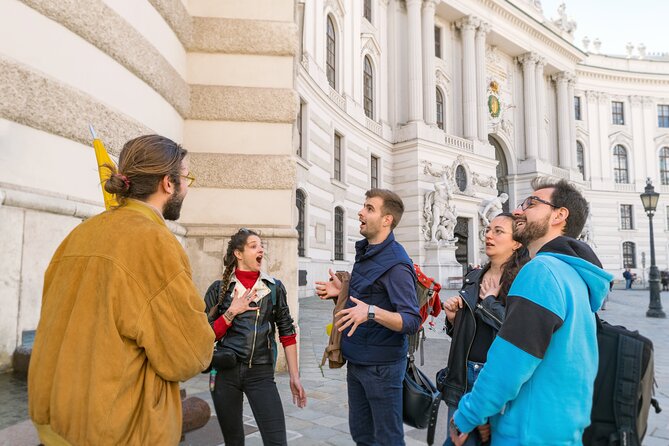
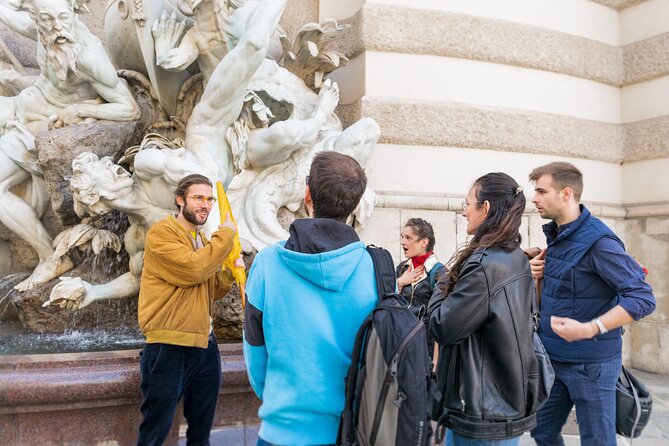
This is not a standard old-town stroll. You will not spend the tour admiring imperial rooms or moving from one famous church to the next. Instead, the guide uses the city center as a crime map, showing how ordinary-looking addresses connect to disturbing events.
That approach works because Vienna’s center is compact. The route begins at Helmut-Zilk-Platz near the Albertina, then moves through the first district before finishing on Rauhensteingasse. You get a useful orientation to central Vienna along the way, but the main purpose is to hear the stories attached to each location.
Guide Ben is especially important to the experience. He researches the cases himself and has a knack for connecting personal crimes to larger events. The transitions between stops are part of the appeal. You are not simply dropped at a site and handed a grisly anecdote. The walk builds from one tale to another, with the city streets providing the thread.
The complimentary smartphone audio guide adds flexibility, although the live guide remains the central feature described for this experience. You should arrive with your phone charged. The tour is offered in English and is limited to a maximum of 20 people, small enough for a more personal walk than a large coach group.
More hidden corners of Vienna:
- Vienna: Guided Walking Tour of City Highlights & Hidden Gems
★ 4.9 · 2,180 reviews - Vienna: Hidden Secrets and Local Stories Walking Tour
★ 4.8 · 221 reviews - Vienna: Courtyards & Hidden Places Walking Tour
★ 4.8 · 189 reviews
From Capuchin dungeons to a ruined acting career
The first stop is at Tegetthoffstraße 2, connected with the Capuchin monastery. The story centers on Father Innocentius, who discovered a dungeon beneath the monastery where monks could be confined for years, sometimes decades.
The reasons for imprisonment could be remarkably petty. Unauthorized afternoon walks and one-time abuse of a monastery official were among the alleged causes. Father Innocentius reported the dungeon to Emperor Joseph II, after which the dungeon was closed and the priest was sent to Lviv for his safety.
His later life sounds like a separate adventure. He became a Protestant, a Freemason, and an adviser to the tsar. I like this opening because it introduces one of the tour’s strongest themes: official religious and political systems could produce bizarre forms of punishment, while the people who exposed them could pay a heavy price.
At Trattnerhof, you hear about the Jaroszynski murder case and the actress Therese Krones. Her connection to the crime damaged her career, even though she had little to do with the murder itself.
The popular version blamed her extravagant desires for pushing Jaroszynski toward despair and crime. The fuller account points instead to his gambling addiction and serious debt. This stop is useful because it shows how quickly public gossip can turn a crime into a morality tale, especially when a famous woman is involved.
Palais Bathory and the danger of a famous legend
At Augustinerstraße 12, the route reaches Palais Bathory, associated with Elisabeth Bathory. You will hear the familiar story of the so-called Blood Countess, accused of murdering more than 600 young women and bathing in their blood to preserve her youth.
The guide presents the central question clearly: was Bathory one of history’s worst serial killers, or the target of a political plot designed to remove a powerful countess? That uncertainty makes this more than a simple monster story.
You should expect the tale to be treated as a disputed case rather than a proven list of facts. The stop also shows how a person can become a legend far beyond the surviving evidence. If you enjoy sorting documented events from later invention, this will be one of the more interesting sections.
At Graben and Kohlmarkt, the atmosphere changes from aristocratic crime to a modern conspiracy. The story centers on Udo Proksch, whose connection to Demel helped provide the setting for planning the Lucona affair in the 1970s.
A heavily insured freighter was sent toward Asia with an explosive charge concealed aboard. The resulting disaster involved mass murder and major insurance fraud. The investigation took years because Proksch had connections in many directions.
This stop works particularly well for anyone interested in political corruption and organized deception. It also reminds you that Vienna’s darker stories are not limited to medieval legends. Some are close enough to the present to feel unsettlingly familiar.
Herrengasse: mass murder and a spy scandal
Herrengasse delivers two very different stories. At Ferstel Palace, you learn about the former Zu den Fünf Morden house, the scene of medieval Vienna’s most notorious mass murder.
The crime involved five victims, including a seven-year-old child. The punishment was impalement, considered fittingly terrible by the authorities. The executioner had little experience with this method, so the process lasted an extremely long time.
This is one of the tour’s hardest stories, not just because of the crime but because it exposes the cruelty of the justice system. Medieval punishments were meant to frighten the public as much as punish the offender. You are looking at an elegant modern building while imagining a street once associated with spectacle and public death.
Opposite Palais Ferstel, the former Hotel Klomser marks the end of Colonel Alfred Redl’s life. His suicide closed the monarchy’s greatest spy scandal.
Redl’s espionage damaged the reputation of the army and exposed the weakness of the underfunded Evidenzbureau, the empire’s intelligence service. The affair may also have contributed to the conditions that led toward the First World War.
This is one of the most historically important stops because the crime reaches beyond one person. Redl’s actions revealed institutional weakness at a dangerous moment. If you want the tour to connect individual wrongdoing with major European events, pay close attention here.
A few more Vienna tours worth weighing up
- Vienna: Guided Walking Tour of City Center Highlights
★ 4.7 · 4,989 reviews - Vienna: City Cruise with Optional Lunch
★ 3.4 · 3,982 reviews - Vienna: City Cruise
★ 3.3 · 2,978 reviews - Vienna: City Sightseeing Tour in an Electro Vintage Car
★ 4.7 · 1,085 reviews
A blacksmith, a murder, and a political lynching
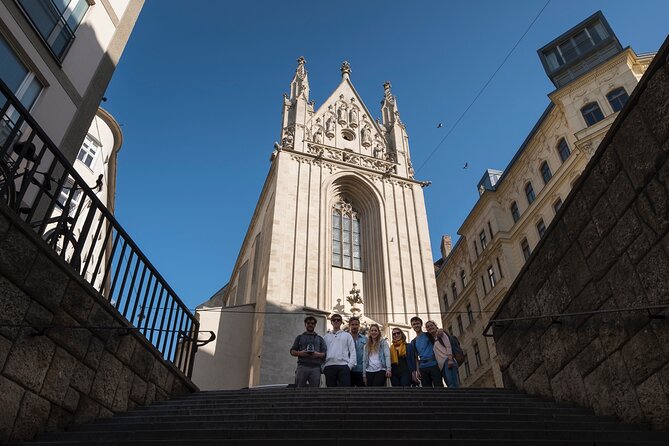
At Molker Bastei, the story becomes particularly grim. Anna Gaugisch was murdered and dismembered by her boyfriend, Raimund Lewisch, in 1861.
Some body parts were found in the Danube, while others were found in a nearby forge. Lewisch wanted to remove a woman who had become pregnant by him. Before the murder, other blacksmiths had noticed him dissecting a cat.
The brief stop does not require much physical sightseeing, but the setting helps show how close violent acts once were to ordinary workspaces and residential streets. This is not a story for anyone sensitive to graphic crime details.
Am Hof brings you into the revolutionary year of 1848. Here, the war minister Theodor Baillet de Latour was lynched during the political violence that marked the beginning of the Vienna October Revolution.
The civil arsenal was also located nearby and was looted during the upheaval. This stop gives the walk a wider political frame. Vienna was not always the calm imperial capital suggested by its grand façades. Revolution could bring public anger, mob violence, and the collapse of authority into the very center of the city.
The Hannaken fountain and a doctor who needed victims
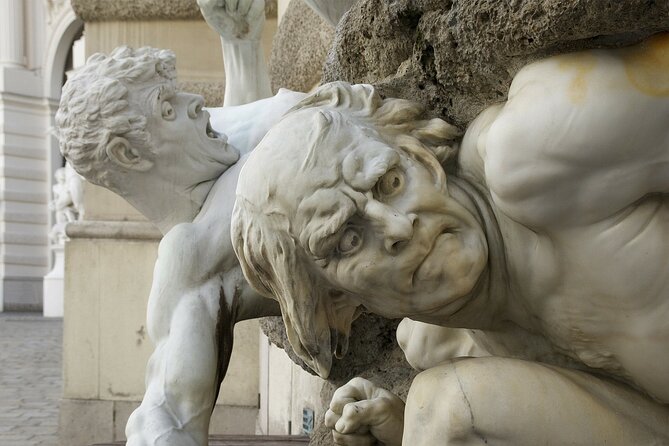
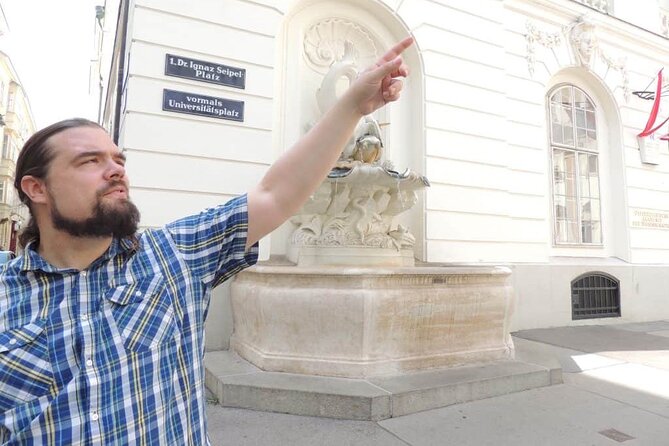
At the Hannaken Fountain, the subject is unusual rather than simply brutal. The Hannaken were a Moravian minority whose members often came to Vienna looking for work. The fountain depicts two men carrying an injured companion to the Hannakenkönig, or Hannaken king.
The story says this surgeon created broken bones to improve business. He set traps and obstacles to cause injuries, then treated the people who were hurt.
It is a strange tale, and the fountain gives you something concrete to examine while hearing it. This stop also adds social context that many crime walks miss. You are not only hearing about an alleged criminal. You are learning how a minority community was represented in the city and how public art preserved a particular image of its work.
At Maria am Gestade, the subject is the Zahlheim case and the last wheeling execution in Vienna. Wheeling was an exceptionally cruel death penalty used for murderers and had already been abandoned in many countries.
The case was especially notable because it occurred under Joseph II, who generally opposed capital punishment. The facts forced him to make an exception. This is a strong reminder that reform was not always steady or complete. Even rulers known for enlightened policies could be pushed back toward brutal punishment by public pressure and a shocking crime.
Hoher Markt and the dangers of imagined jealousy
At Hoher Markt, you hear about Thekla Riener and her husband, Anton Grünborn. He tortured her with instruments from the courthouse because he believed she had a lover.
There was no lover. His jealousy was built on imagined affairs and a series of irrational actions. He eventually killed her by accident, and her parents later became insane.
The story is upsetting, but it also fits the tour’s larger interest in motive. Not every crime begins with money or political ambition. Some grow from delusion, possessiveness, and escalating fear. The guide’s job here is to keep the story tied to the social setting rather than turning it into a quick shock anecdote.
Stephansdom and the punishment of bad bakers
Near St. Stephen’s Cathedral, the tour examines the legend of Vienna’s supposed standard loaf of bread. The story claims that bakers faced harsh quality-control measures if their loaves failed to meet the city’s rules.
The more solid part of the tradition concerns the baptism of bakers. A bad baker could be locked in a cage and dipped several times into the Danube. Similar punishments for quarrelsome women existed in English-speaking countries.
This is a lighter stop by comparison, though the punishment was still cruel. It shows how medieval authorities used public humiliation, water, and physical danger to enforce standards and settle disputes. The cathedral provides a memorable backdrop, but the point is not the church interior. It is the old city’s system of control.
At Steffl, you learn about the former Malefizspitzbubenhaus, which served as an executioner’s apartment and dungeon. The only witch burned in Vienna, the woman known as Plainacher, was held and tortured there.
She was accused of bewitching her epileptic granddaughter and summoning demons. Witch persecution was not common in Vienna, but public pressure pushed the city judge into action.
This stop is valuable because it complicates the usual picture of witch trials. The story is not evidence that Vienna regularly burned witches. Instead, it shows how fear and public opinion could force authorities into an exceptional act.
A Viennese Romeo and Juliet at Himmelpfortgasse
The final story takes place at the former Himmelpfort monastery on Himmelpfortgasse. In 1319, a nun was walled in because she refused to leave the man she loved, whom her father despised.
The family conflict resembles a Viennese version of Romeo and Juliet. A mayor and his archenemy had children who loved each other. When the mayor’s son asked for Anna’s hand, her father sent her to a convent instead of accepting the match.
The story gives the walk a tragic ending rather than another burst of violence. It also shows how family power, marriage, religion, and city politics could control a young woman’s life. The stop is short, but it leaves you with a strong sense of how personal choices could be treated as threats to family honor.
What the $46.13 price buys you
At $46.13 per person, this is not the cheapest way to walk around Vienna. You are paying for a specialist theme, guide preparation, and a carefully connected route through the center rather than for admission to a museum or palace.
The value is best if you already plan to see the major sights and want something that adds a new layer to them. The tour passes near famous places, but it tells you what happened around them, underneath the polished tourist image. That can make the city feel more legible afterward.
The price is harder to justify if you want a broad introduction to Vienna, a formal architectural tour, or time inside monuments. Fourteen stops in about two hours means the pace is brisk, and most stops are outside with no admission included.
The maximum group size is 20. That is a reasonable limit for a central-city walk, though the quality of the experience will still depend on the guide’s delivery and how easily you can hear in busy streets.
Practical details for making the walk work
The meeting point is Helmut-Zilk-Platz, Albertinaplatz 2 to 3, in Vienna’s first district. The route ends on Rauhensteingasse, also in the center, so you finish in a useful area for continuing your sightseeing.
The tour lasts about two hours and is near public transportation. Most people can participate, but you should be comfortable walking between 14 outdoor locations at a steady pace. Good weather is required, so a poor-weather cancellation may lead to a different date or a full refund.
Free cancellation is available up to 24 hours before the start time. A cancellation inside that period is not refundable, and changes are not accepted then. The experience also requires a minimum number of participants, so an undersubscribed departure can be rescheduled or refunded.
Because the material includes murder, torture, executions, and dismemberment, I would not book this as a family activity without checking that everyone is comfortable with those subjects. Adults interested in true crime, unusual local stories, or the less polished side of European history are the natural audience.
Should you book Terrible crimes in Vienna?
Book it if you have already seen Vienna’s headline sights and want the city to surprise you again. The best parts are the lesser-known addresses, the links to political events, and Ben’s personal research into cases that rarely appear in standard sightseeing tours.
I would also recommend it to anyone planning a visit to the Vienna Crime Museum, since the walk gives you outdoor context before or after a museum visit. The route can sharpen your sense of place: a palace, fountain, church, or street corner becomes connected to a very specific human story.
Skip it if graphic crime is not your thing, if you need an easygoing family walk, or if you want to spend your sightseeing time inside Vienna’s major buildings. For the right audience, though, $46.13 buys a memorable change of pace and a fresh way to read the old city.
FAQ
Where does the tour begin?
It begins at Helmut-Zilk-Platz, Albertinaplatz 2 to 3, 1010 Vienna, Austria.
Where does the tour finish?
The tour ends on Rauhensteingasse in Vienna’s first district.
How long does the experience last?
The walk lasts approximately two hours.
What language is the tour offered in?
The tour is offered in English.
How much does the tour cost?
The listed price is $46.13 per person.
Is a smartphone audio guide included?
Yes. A complimentary smartphone audio guide is included.
How large can the group be?
The maximum group size is 20 people.
Can most people participate?
Yes. Most people can participate, and the route is near public transportation.
What happens if the weather is poor?
The tour requires good weather. If it is canceled because of poor weather, you will be offered another date or a full refund.
Just added around Vienna
- Private Tour from Vienna to Melk and Dürnstein★ 4.5 · 3 reviews
- Vienna: Johann Strauss 200th birthday anniversary exhibition★ 4.7 · 3 reviews
- Vienna Private Full Day Tour – Tickets to Schönbrunn & Lunch★ 5.0 · 3 reviews
- Private Salzburg Day Trip from Vienna★ 4.0 · 3 reviews
- Vienna: Entry Ticket Belvedere 21 & Contemporary Art★ 4.3 · 3 reviews
- Full-Day Private Trip from Vienna to Budapest★ 4.5 · 3 reviews
- Vienna by Night: Private Evening Food and Drink Tour★ 5.0 · 3 reviews
- 1.5 Hour Cinematic Style Portrait Photoshoot and Tour in Vienna★ 4.5 · 3 reviews
Vienna Hidden Gems Tours, compared.
Guided Walking Tour of City Highlights & Hidden Gems
Read our review →
Private Hidden Vienna Walk — Stories Behind Quiet Corners
Read our review →
Food Tasting Tour in Hidden Gems of Vienna for Small Groups
Read our review →
Viennese Wine Tasting in a Private Hidden Wine Cellar
Read our review →Browse the lists this tour appears in