
Reviewed · MUSEUMS
Leopold Museum Vienna Entrance Ticket
The Leopold Museum gives you one of Vienna’s clearest introductions to Austrian modern art, especially the unsettling, brilliant work of Egon Schiele. The museum’s light-filled building holds more than 5,000 objects, but you can focus your visit on the major artists and finish in about two to three hours.
I like the freedom to arrive when it suits you and pause wherever you wish. I also like the excellent concentration of Schiele, Klimt, Kokoschka, Moser, and other Austrian artists under one roof. The main drawback is that the museum may feel smaller than expected, especially if you come hoping for a large Klimt collection or a full-day art marathon.
In This Review
- Key things to know before you go
- Why the Leopold Museum matters in Vienna
- Begin with the building and the MuseumsQuartier setting
- Follow Vienna from historicism to modern art
- Give Egon Schiele the time he deserves
- Find Klimt’s Death and Life
- See the Wiener Werkstätte and modern design
- Continue into interwar and later Austrian art
- Use your two to three hours wisely
- Enjoy Maria Theresa Square and Hofburg views
- Take a break at Café Leopold
- Is the $22.98 ticket good value?
- Important ticket and timing details
- Who should book this museum ticket?
- Should you book the Leopold Museum?
- FAQ
- How long does the Leopold Museum visit take?
- What artists can I see at the Leopold Museum?
- Does the ticket include a guide?
- Is the audio guide included in the ticket price?
- Can I see Egon Schiele’s work at the museum?
- Does the museum have many Klimt paintings?
- What happens if I need to cancel?
Key things to know before you go
- Egon Schiele is the main event: The museum holds the largest collection of his work in the world, including paintings and drawings.
- Klimt is represented selectively: You will see the major Death and Life, but not a large room packed with Klimt masterpieces.
- Plan on two to three hours: That is enough time for the main collection without rushing.
- You explore independently: No guide is included, and the audio guide costs an additional EUR 4.
- Look out the windows: Maria Theresa Square and the Hofburg Palace provide a fine Vienna view between galleries.
- Check the voucher instructions: Although the booking offers a mobile ticket, the instructions say to present the voucher at the cashier desk and advise printing it.
Why the Leopold Museum matters in Vienna
Vienna is filled with imperial architecture, grand churches, and polished historic interiors. The Leopold Museum gives you a different city: Vienna at the turn of the 20th century, when old artistic rules were breaking apart and modern art was taking shape.
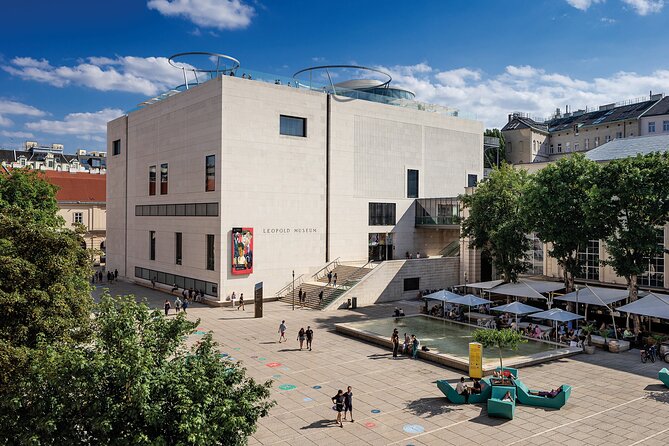
The museum is in the MuseumsQuartier, one of central Vienna’s main cultural areas. Its modern architecture is bright and functional, with large windows that bring daylight into the galleries. The outside can feel somewhat cold and severe, but the interior is more inviting and works well as a setting for the art.
The collection was built over five decades by Rudolf and Elisabeth Leopold. It now belongs to a private foundation created with the Republic of Austria and the Austrian National Bank. That background matters because this is not a random selection of famous paintings. The collection follows the development of Austrian art from the 19th century through the interwar period and into the postwar years.
You can arrive with a narrow goal, such as seeing Schiele, or let the museum show you how the artistic world changed in a short period. I recommend the second approach. The best part of the visit is not simply checking off famous names. It is watching Vienna move from conservative historicism toward the daring style now associated with the Wiener Moderne.
More museums in Vienna:
- Vienna: Skip-the-Line Sisi Museum, Hofburg and Gardens Tour
★ 4.8 · 5,918 reviews - Vienna Kunsthistorisches Museum Day Admission Ticket
★ 4.6 · 3,690 reviews - Tickets for the Albertina Exhibitions
★ 4.7 · 2,126 reviews
Begin with the building and the MuseumsQuartier setting
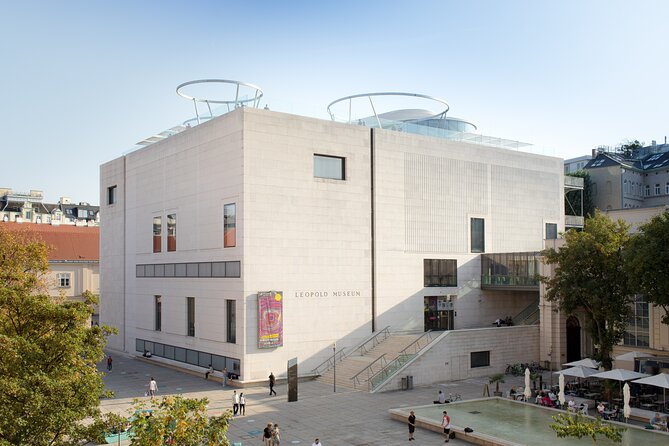
Before entering, take a moment to look at the museum itself. The Leopold is an angular modern building surrounded by the larger MuseumsQuartier complex. The setting makes it easy to combine this visit with other cultural stops, although the ticket described here covers the Leopold Museum only.
Once inside, the building’s light helps you get your bearings quickly. You are not being led from room to room by a guide, so the open layout gives you control over the pace. You can move quickly through familiar material, slow down for a Schiele drawing, or stop at a window when the art becomes intense.
The setting also makes this a practical choice for independent sightseeing. You do not need to fit into a group schedule, and you can decide how much attention to give the permanent collection and any temporary exhibitions included with admission.
Follow Vienna from historicism to modern art
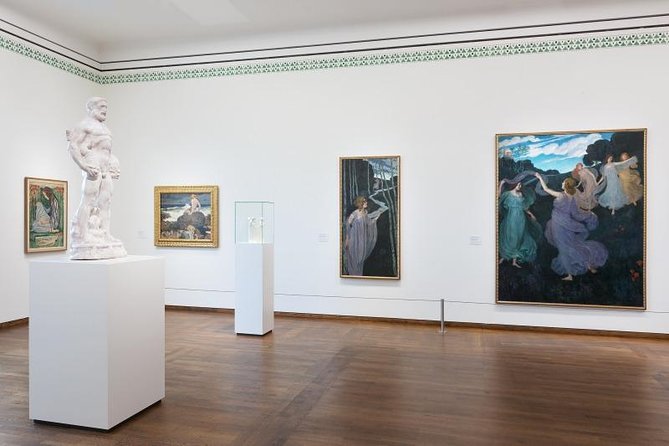
The collection is most useful when you see it as a story. Earlier 19th-century works by artists such as Ferdinand Georg Waldmüller, Friedrich Gauermann, August von Pettenkofen, Anton Romako, Emil Jakob Schindler, and Carl Schuch help establish the older Austrian tradition.
From there, the museum shows how quickly artistic tastes shifted. Mood Impressionism loosened the grip of strict historicism, and the emerging Vienna modern movement brought new ideas about decoration, design, the human body, and daily life.
You will encounter major names from this period, including Gustav Klimt, Oskar Kokoschka, Richard Gerstl, Koloman Moser, and Otto Wagner. These artists did not all work in the same way, which keeps the collection from feeling like a single-style display.
Klimt gives you the decorative, symbolic side of Vienna around 1900. Kokoschka and Gerstl push toward a more emotionally charged form of painting. Moser and Wagner show that modern design was not limited to framed pictures. It reached into furniture, interiors, architecture, and everyday objects.
That wider view is one of the museum’s strengths. You are not just looking at paintings by famous names. You are seeing how the idea of art expanded into the objects and spaces of ordinary life.
Give Egon Schiele the time he deserves
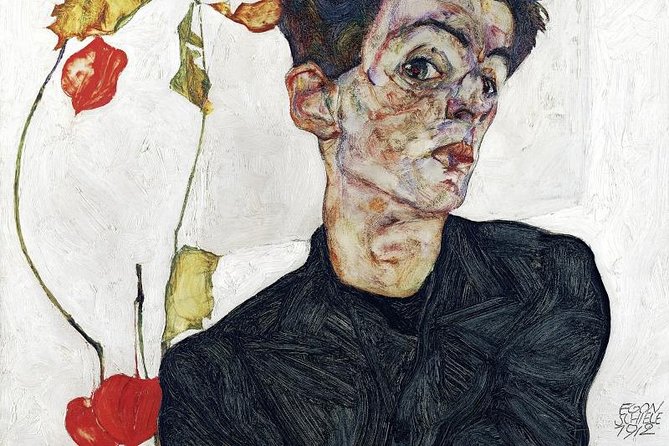
If you have one priority at the Leopold, make it Egon Schiele. The museum’s collection is the largest of its kind in the world, and it includes both paintings and drawings.
Schiele’s work can be difficult. His figures are angular, exposed, and often uncomfortable to look at. That is exactly why you should not rush through the rooms. The drawings reward close attention to line and gesture, while the paintings show how he used distorted bodies and tense poses to express inner feeling.
You may find the Schiele rooms emotionally heavy. One of the lower-rated responses to the visit described the art as depressing and the atmosphere as austere. That reaction is understandable. This is not a museum built around easy decoration or cheerful crowd-pleasers.
At the same time, the difficult mood is part of the point. Schiele’s work helps explain why Vienna’s modern art still feels so forceful. His figures do not politely sit inside their frames. They challenge you, and the museum gives you enough examples to understand his development rather than offering only one famous image.
Allow at least 45 minutes if Schiele is your reason for coming. You can spend less time if you are mainly interested in Vienna’s design history, but rushing past this collection would miss the museum’s strongest feature.
A few more Vienna tours worth weighing up
- Vienna: Classic Ensemble Vienna in St. Peter’s Church Ticket
★ 4.7 · 4,819 reviews - Vienna: Tickets for Mozarthaus Vienna with Audio Guide
★ 4.2 · 2,344 reviews - Vienna: Skip-the-Line Entrance Ticket to the Danube Tower
★ 4.5 · 2,303 reviews - Sigmund Freud Museum Ticket
★ 4.6 · 1,668 reviews
Find Klimt’s Death and Life
Gustav Klimt is another major reason to visit, but set your expectations correctly. The Leopold has important Klimt works, including Death and Life, described as one of his most important figurative paintings.
Death and Life is the Klimt centerpiece here. It is a substantial work, and the combination of ornament, mortality, and human figures gives you a good sense of Klimt’s symbolic style. Take time to examine the contrast between the richly patterned group of living figures and the darker personification of death.
The museum does not contain a large number of Klimt paintings. If your main goal is to see room after room of Klimt, this ticket may disappoint you. The Leopold works better for someone who wants Klimt as part of a broader account of Austrian modern art.
For a fuller Klimt-focused day, you would need to visit other Vienna collections separately. This museum’s value comes from the conversation among Klimt, Schiele, Kokoschka, Moser, and their peers.
See the Wiener Werkstätte and modern design
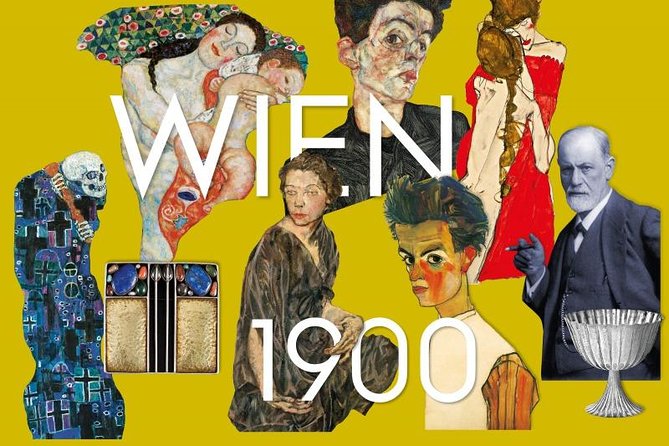
The Leopold’s art collection is supported by a strong display of Fin de Siècle objects. Otto Wagner, Adolf Loos, Dagobert Peche, Josef Hoffmann, and Koloman Moser represent the close connection between art, architecture, and design in Vienna.
This section can be especially rewarding if you are interested in interiors or decorative arts. The Wiener Werkstätte aimed to bring careful design into everyday objects, and the museum helps you see how that ambition sat beside painting and drawing.
You might be surprised by how modern some of these objects look. Their shapes and patterns can feel cleaner and less tied to the past than the grand buildings outside. They also explain why Vienna’s turn-of-the-century art is often remembered as a complete cultural movement rather than a short list of painters.
Do not skip this material just because you came for Schiele. It gives the paintings a useful setting and shows how the period’s ideas reached beyond the gallery wall.
Continue into interwar and later Austrian art
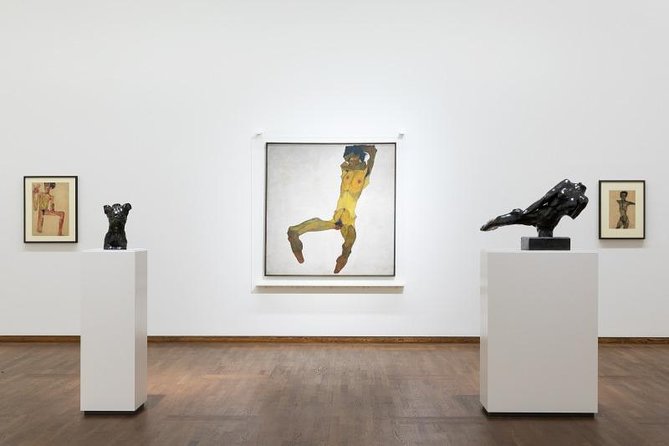
The museum also covers Austrian art between the two world wars. Artists such as Albin Egger-Lienz, Anton Kolig, and Herbert Boeckl show how the country’s art changed after the confident world of Vienna around 1900 had come to an end.
This part may be less familiar than the Schiele and Klimt rooms, so it is easy to pass through quickly. I would slow down if you have already seen the headline works. The interwar collection explains that Austrian modernism did not stop with the Vienna Secession or disappear after Schiele’s death.
Works from the postwar generation appear as well, along with occasional displays of 19th-century art. The result is a collection with a longer reach than the museum’s famous Schiele rooms suggest. The exact presentation can change with special exhibitions, so the balance between periods may vary during your visit.
Use your two to three hours wisely
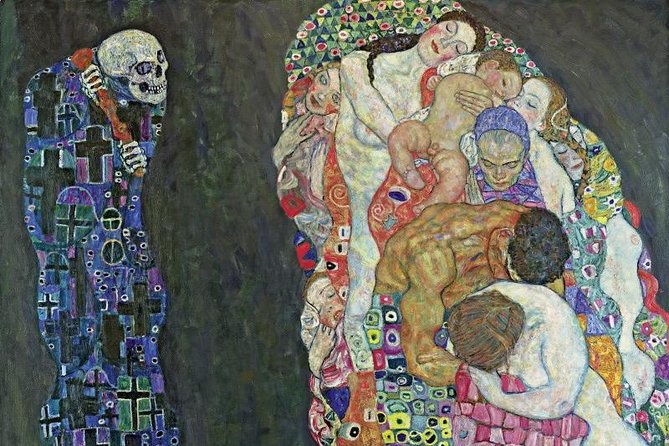
A two-hour visit is enough for the major highlights. You can see the main Schiele rooms, Death and Life, the Vienna modern movement, and some design objects without racing.
For a slower visit, plan closer to three hours. That gives you time to read labels, compare artists, visit special exhibitions, browse the museum shop, and pause at the windows. The museum is not enormous, so you do not need to reserve an entire day unless you prefer a very slow pace.
Here is a practical way to organize your time:
- Spend the first 15 minutes getting oriented and looking over the building’s main displays.
- Set aside 45 to 60 minutes for Schiele and related Austrian modern art.
- Give Klimt’s Death and Life a focused pause rather than treating it as a quick photo stop.
- Use 30 to 40 minutes for Wiener Werkstätte objects, architecture, and design.
- Finish with the interwar and later Austrian works, special exhibitions, the views, or the café.
You can also reverse this order if the museum is busy. Head first to the Schiele rooms, then work through the rest at your own pace.
Enjoy Maria Theresa Square and Hofburg views
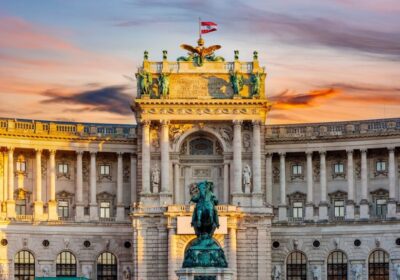
The windows are a small but valuable part of the visit. From the museum, you can look toward Maria Theresa Square and the Hofburg Palace.
These views help connect the modern art inside with the imperial city outside. The contrast is sharp: the museum presents artistic upheaval, while the Hofburg represents centuries of Habsburg power and ceremony.
Do not leave without taking a few minutes here. After the intensity of Schiele and the decorative density of Klimt, a view across central Vienna gives you a welcome pause. It also makes the museum feel tied to the city rather than sealed off from it.
Take a break at Café Leopold
Café Leopold provides a place to sit and think over what you have seen. Food and drinks are not included in the ticket, so treat it as an optional extra rather than part of the admission value.
A café stop makes sense if you want to stretch the visit toward three hours. It is also useful if one person in your group needs a break while another wants to spend more time in the galleries.
The café has been praised for its food, but you should budget separately for anything you order. If you are watching costs, the museum itself gives you plenty to see without adding a meal.
Is the $22.98 ticket good value?
At $22.98 per person, this is a reasonable ticket for a specialist museum with a world-leading Schiele collection. The value is strongest if you care about Austrian modern art and would otherwise be disappointed to miss the museum’s most important works.
The ticket also includes unlimited access to the permanent collection and exhibitions during your visit. That matters because you can take a slower approach without worrying about a timed guided group moving on.
The value is less clear if you expect a huge museum or a broad selection of Klimt. The Leopold is a focused museum, and some of its exhibition space is devoted to photographs, the shop, and material beyond the main painting collection. One assessment described it as a smaller museum that can be seen in about two hours. That is fair, though smaller does not mean thin if the subject suits you.
The admission does not include a guide or audio guide. An audio guide is available in German, English, French, and Italian for an extra EUR 4. If you want context but do not want to read every label, that small supplement may be worthwhile.
Important ticket and timing details
The experience is listed as a mobile ticket, but the instructions also say to present the Viator voucher at the cashier desk in exchange for the current ticket and advise printing the voucher. That is an important detail. Bring a printed copy if you can, and keep the voucher accessible on your phone as a backup.
The stated opening schedule lists Monday hours from 10:00 AM to 6:00 PM for the period February 1, 2024 through February 14, 2027. Check the operating details for your chosen date before setting out, especially if your visit falls on a different weekday or near a holiday.
Children must be accompanied by an adult. A reduced child ticket requires the relevant identification card. Most people can take part without special arrangements.
Free cancellation is available if you cancel at least 24 hours before the experience start time. Changes or cancellations inside that 24-hour window are not accepted for a refund, and the cut-off follows local Vienna time.
Who should book this museum ticket?
I would choose this ticket if you like modern art, portraiture, drawing, design, or the cultural history of Vienna around 1900. It is also a good fit if you want to sightsee independently and dislike being hurried through galleries.
Families with older children may appreciate the freedom to split up and regroup, though the darker Schiele material may not suit every child. Children need adult supervision, and the child discount requires identification.
You may want to skip it if your main goal is a large collection of Klimt paintings, a guided explanation, or a museum that takes most of the day. The Leopold has no included guide, and the audio guide costs extra.
Should you book the Leopold Museum?
Book it if Egon Schiele is high on your Vienna list. The scale and quality of the Schiele collection make this one of the city’s most useful stops for understanding his work, while Klimt’s Death and Life and the Wiener Werkstätte displays add real depth.
Go with realistic expectations. This is a focused two to three-hour museum, not a giant encyclopedic collection. The building’s exterior may feel stark, some works can feel emotionally severe, and Klimt appears in a supporting role rather than dominating every room.
For the price, the independent format is practical, the central location is convenient, and the chance to see so much Schiele in one place is hard to match. Print your voucher, allow two hours at minimum, and leave time for the Hofburg view.
FAQ
How long does the Leopold Museum visit take?
The visit takes approximately two to three hours. You can see the main collection in about two hours, or stay longer for special exhibitions, the museum shop, the café, and a slower look at the art.
What artists can I see at the Leopold Museum?
The collection includes Egon Schiele, Gustav Klimt, Oskar Kokoschka, Richard Gerstl, Koloman Moser, Herbert Boeckl, Otto Wagner, and other Austrian artists. It also includes selected 19th-century, interwar, and postwar works.
Does the ticket include a guide?
No. A guide is not included. An audio guide is available separately in German, English, French, and Italian for EUR 4.
Is the audio guide included in the ticket price?
No. The audio guide costs an additional EUR 4.
Can I see Egon Schiele’s work at the museum?
Yes. The Leopold Museum has the largest collection of Egon Schiele works in the world, including paintings and drawings.
Does the museum have many Klimt paintings?
The museum has major Klimt works, including Death and Life, but it does not have a large Klimt collection. If you want many Klimt paintings, you may find the selection limited.
What happens if I need to cancel?
You can receive a full refund if you cancel at least 24 hours before the experience start time. Cancellations or changes made less than 24 hours before the start time are not accepted for a refund.
Just added around Vienna
- Private Tour from Vienna to Melk and Dürnstein★ 4.5 · 3 reviews
- Vienna: Johann Strauss 200th birthday anniversary exhibition★ 4.7 · 3 reviews
- Vienna Private Full Day Tour – Tickets to Schönbrunn & Lunch★ 5.0 · 3 reviews
- Private Salzburg Day Trip from Vienna★ 4.0 · 3 reviews
- Vienna: Entry Ticket Belvedere 21 & Contemporary Art★ 4.3 · 3 reviews
- Full-Day Private Trip from Vienna to Budapest★ 4.5 · 3 reviews
- Vienna by Night: Private Evening Food and Drink Tour★ 5.0 · 3 reviews
- 1.5 Hour Cinematic Style Portrait Photoshoot and Tour in Vienna★ 4.5 · 3 reviews
Museums, compared.
Skip-the-Line Sisi Museum, Hofburg and Gardens Tour
Read our review →
Vienna Kunsthistorisches Museum Day Admission Ticket
Read our review →

Chocolate Workshop in Chocolate Museum w/ Tasting
Read our review →
St. Stephen’s Cathedral & Dom Museum Wien Tickets
Read our review →
Browse the lists this tour appears in