
Reviewed · HOFBURG & IMPERIAL VIENNA TOURS
Vienna: Imperial Treasury in the Hofburg Palace
The Imperial Treasury is where Vienna’s royal story becomes wonderfully tangible. Inside the oldest part of the Hofburg, you’ll see the Austrian Imperial Crown, Holy Roman Empire regalia, priceless jewels, sacred relics, and an agate bowl once linked with the Holy Grail.
I like the compact layout, which lets you see the main rooms in about an hour, and the chance to examine objects that once belonged to Habsburg emperors and empresses. I also like the unusual pieces, especially the Holy Lance, the giant emerald, and the so-called unicorn horn. The main drawback is ticket handling: a printed voucher is required, and some prepaid visitors still had to wait at the counter to exchange it for an admission ticket.
In This Review
- Key points to know
- Why the Imperial Treasury deserves a place in your Hofburg day
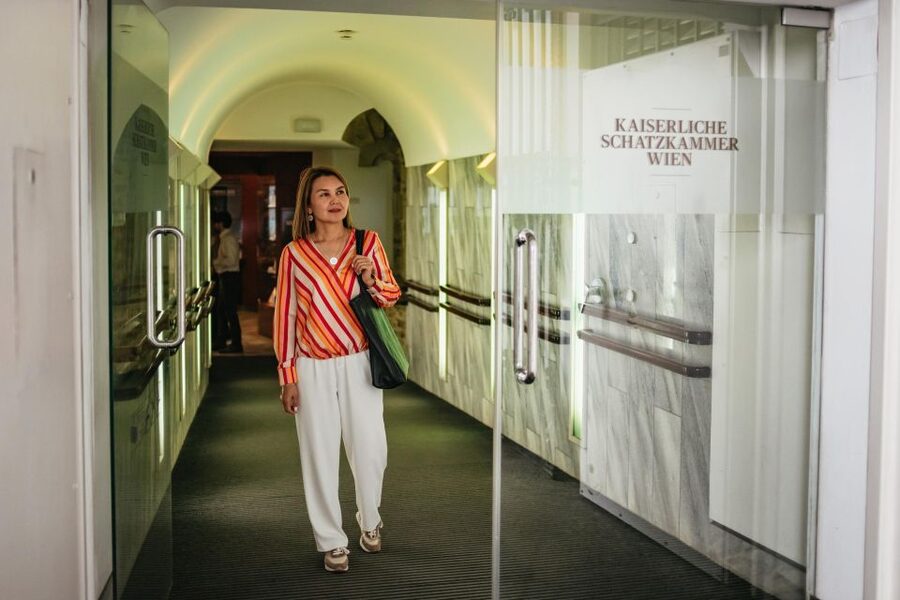
- Entering the Swiss Wing and finding the treasury
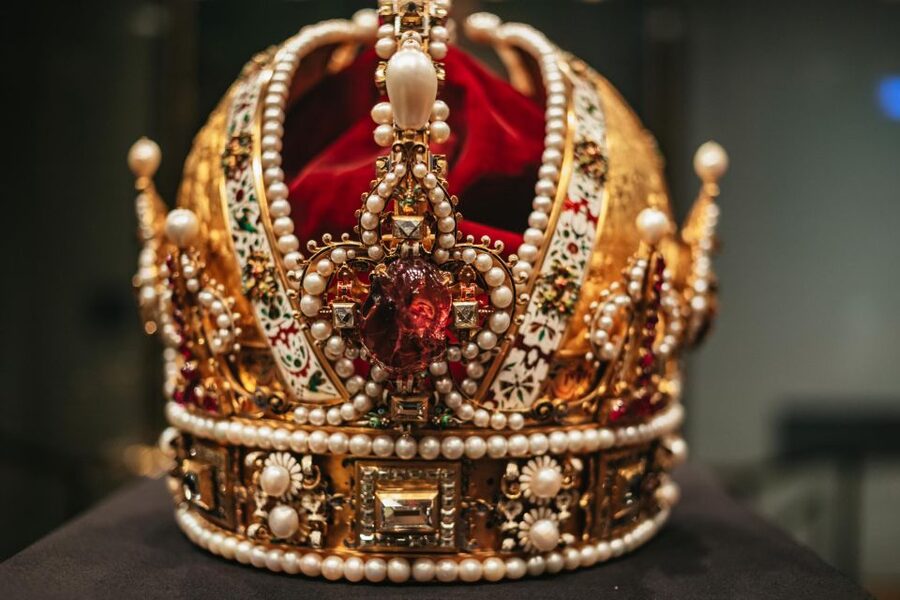
- The Austrian Imperial Crown and Holy Roman Empire regalia
- Jewels, emeralds, and the personal side of the court
- Burgundy treasures, Golden Fleece objects, and court ceremony
- The Holy Lance, Holy Grail, and unicorn horn
- Napoleon II’s cradle and the family story
- Self-guided visit or guide
- How long to spend inside
- Who will enjoy this visit most
- Is the $18 ticket good value?
- Practical tips before you go
- Should you book the Imperial Treasury?
- FAQ
- Where is the Imperial Treasury located?
- How much does admission cost?
- Is a guided tour included?
- Is an audio guide included?
- Do I need a printed ticket?
- How long should I allow for the visit?
Key points to know
- The Austrian Imperial Crown: See one of Europe’s most striking royal crowns, along with the crown jewels of the Holy Roman Empire.
- The Swiss Wing: Enter through the oldest part of the Hofburg Palace, a setting that adds weight to the collection before you even reach the display rooms.
- More than royal jewelry: Look for ecclesiastical objects, ceremonial clothing, keys, relics, Burgundy treasures, and the cradle of Napoleon II.
- Sisi’s personal world: Parts of the original jewelry of Empress Elisabeth are displayed with jewelry linked to Habsburg empresses and princesses.
- Unusual legendary objects: The collection includes the Holy Lance, a huge agate bowl known as the Holy Grail, and a horn identified as a unicorn horn.
- Plan for one to two hours: You can move through quickly in about an hour, but a careful visit with an audio guide can take much longer.
Why the Imperial Treasury deserves a place in your Hofburg day
The Hofburg is a huge palace complex, and it can be hard to picture how power worked here from grand rooms alone. The Imperial Treasury helps fill in the picture. These are not simply pretty objects behind glass. They are crowns used in ceremony, garments worn to display rank, religious relics tied to political authority, and jewels that made the reach of the Habsburg dynasty visible.
The setting matters. The treasury occupies the Swiss Wing, the oldest section of the Hofburg. You enter a part of the palace associated with the early court, then pass into rooms filled with objects gathered across centuries. That combination gives the visit more meaning than viewing royal jewelry in a modern gallery with no connection to the people who owned it.
I would place this visit early in your time in Vienna if you plan to see other Habsburg sights. The imperial symbols and family names appear again and again around the city. Seeing the crowns and regalia first can make later visits to the Hofburg, imperial apartments, or other Habsburg collections easier to follow.
More Hofburg and imperial Vienna:
- Vienna: Skip-the-Line Sisi Museum, Hofburg and Gardens Tour
★ 4.8 · 5,918 reviews - Vienna: Hofburg and Empress Sisi Museum Guided Tour
★ 4.7 · 1,460 reviews - Vienna: Skip-the-Line Hofburg and Empress Sisi Museum Tour
★ 4.8 · 801 reviews
Entering the Swiss Wing and finding the treasury
The meeting point is the Swiss Wing in Vienna’s Hofburg Palace. The palace is a large complex, so give yourself time to find the correct entrance. The most common practical snag is not the exhibition itself, but the ticket exchange.
A printed voucher is required. A digital QR code may not be enough, and some people who had bought tickets ahead still had to stand in line to exchange the voucher for the actual admission ticket. That can erase much of the advantage of booking in advance, especially if you arrive during a busy period.
The ticket costs about $18 per person, with children and young people under 19 generally admitted free. At that price, the treasury is a reasonable choice for anyone interested in European courts, religious art, or royal ceremony. It is less of a bargain if you expect a guided palace tour, since the admission covers entry only.
The treasury is wheelchair accessible. The booking is valid for one day, and flexible cancellation up to 24 hours before the visit is available. Those details are useful if your Vienna schedule is still changing, but the printed-voucher rule deserves more attention than the cancellation policy.
The Austrian Imperial Crown and Holy Roman Empire regalia
The crowns are the natural starting point for many people, and rightly so. The Austrian Imperial Crown is an imposing object, not merely because of its jewels, but because of its shape and symbolism. It was designed to communicate authority from a distance, with every detail carrying a message about faith, dynastic power, and rank.
The crown jewels of the Holy Roman Empire give the visit a wider reach. Here, the story moves beyond Austria and the Habsburg family to the old imperial structure that shaped much of Central Europe. The collection includes the Imperial Crown and other regalia associated with the office of emperor.
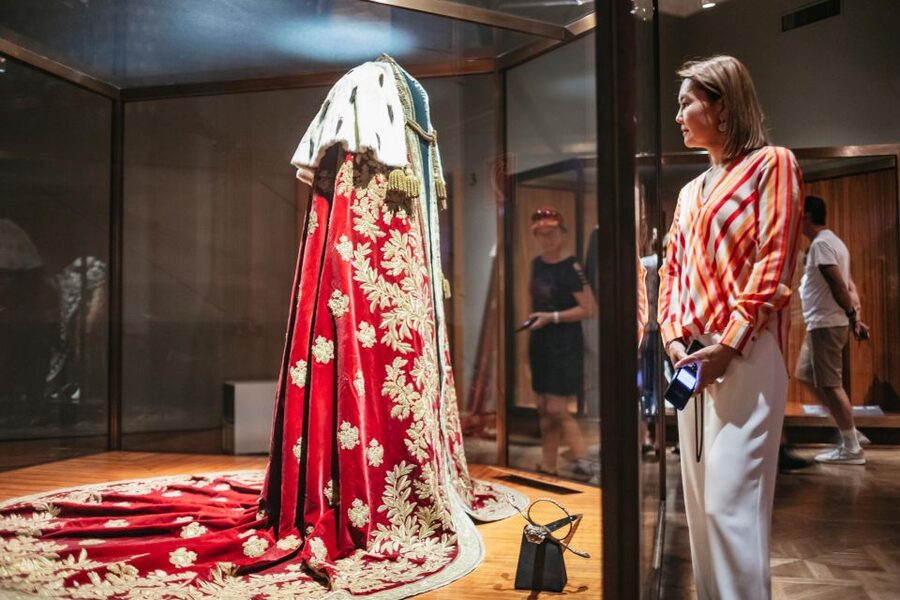
You do not need a strong background in European history to enjoy this section. Look first at the physical details: the scale of the crowns, the precious stones, the clothing, and the objects made for formal use. Then consider their purpose. These were meant to be seen during coronations and major ceremonies, when clothing and jewelry helped turn a ruler into a public symbol.
The displays are clearly marked, and the rooms are generally easy to follow, though the layout can feel confusing at first. I would not rush this section. It gives you the best sense of how the Habsburg court wanted to present itself.
Jewels, emeralds, and the personal side of the court
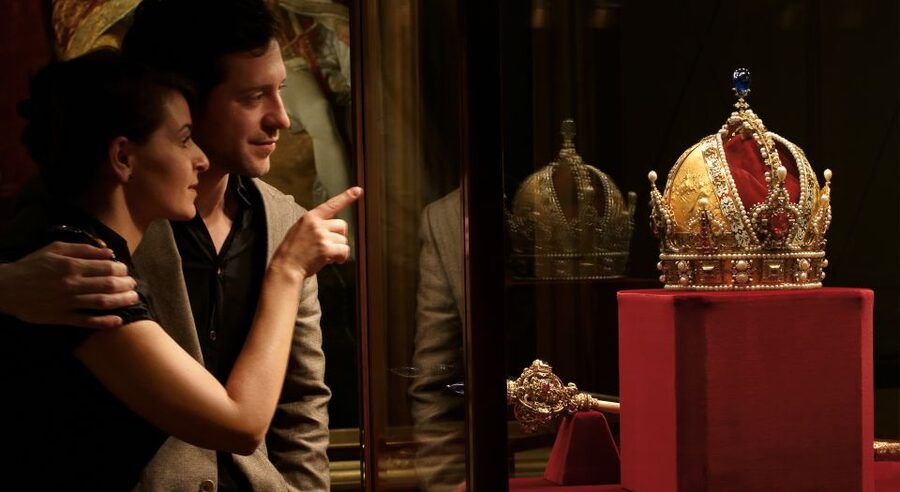
The jewelry rooms bring the imperial family closer to everyday human scale. You’ll see pieces associated with Habsburg empresses and princesses, including parts of the original jewelry of Empress Elisabeth, better known as Sisi.
Sisi’s fame can sometimes overshadow the other women of the dynasty, but the display helps place her within a larger court tradition. Jewelry was not only personal decoration. It signaled marriage ties, wealth, family connections, and position at court. A necklace or brooch could carry almost as much social meaning as a crown.
The collection also includes very large and unusual precious stones. Among the highlights is an emerald described as one of the largest in the world, with the collection also presenting what is identified as the world’s largest cut emerald. The sheer size is what makes these pieces memorable. Even if you are not a jewelry enthusiast, you can appreciate how rare and difficult such objects must have been to obtain, cut, and preserve.
Lighting has been a concern for some visitors, particularly around darker objects and intricate reliquaries. Take your time and move close enough to read the labels where permitted. The presentation is generally attractive, but not every object is equally easy to see at a glance.
A different side of Vienna on the same trip:
- Vienna: Vivaldi’s Four Seasons Concert in Karlskirche
★ 4.7 · 14,951 reviews - Vienna: Spanish Riding School Training
★ 3.9 · 9,281 reviews - Vienna: Skip-the-cashier-desk-line Giant Ferris Wheel Ride
★ 4.5 · 7,859 reviews - Vienna: Schönbrunn Palace & Gardens Skip-the-Line Tour
★ 4.7 · 7,739 reviews
Burgundy treasures, Golden Fleece objects, and court ceremony
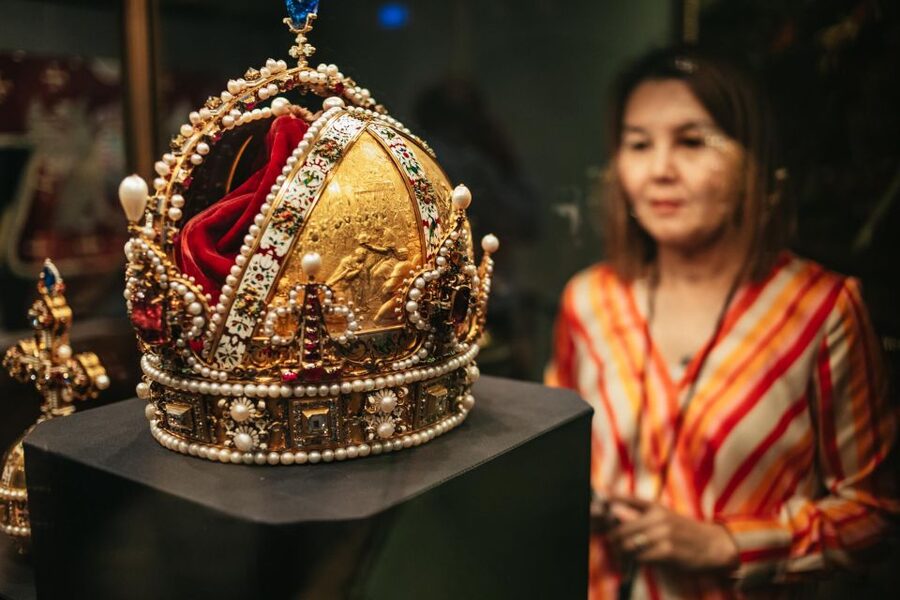
One of the more rewarding parts of the treasury is the material connected with the Order of the Golden Fleece. This was a major chivalric order, and its objects show how the Habsburgs used ceremony and allegiance to strengthen their rule.
You’ll also find collections from 15th-century Burgundy. These pieces widen the story beyond Vienna and show how the Habsburg inheritance accumulated through dynastic links and political connections. The treasury is at its best when you notice those layers. A single room may connect Burgundy, the Holy Roman Empire, Austria, and the later Habsburg court.
Do not overlook the less glamorous objects. Ceremonial clothing, tabards, and chamberlains’ keys can be more revealing than another glittering jewel. They show how the palace functioned, who had access to the ruler, and how hierarchy was made visible in daily court life.
The tabards are especially useful for visitors who want more than a parade of precious stones. Their colors and designs helped identify office and rank. The chamberlains’ keys likewise point to an organized court where access was controlled and status had practical consequences.
The Holy Lance, Holy Grail, and unicorn horn
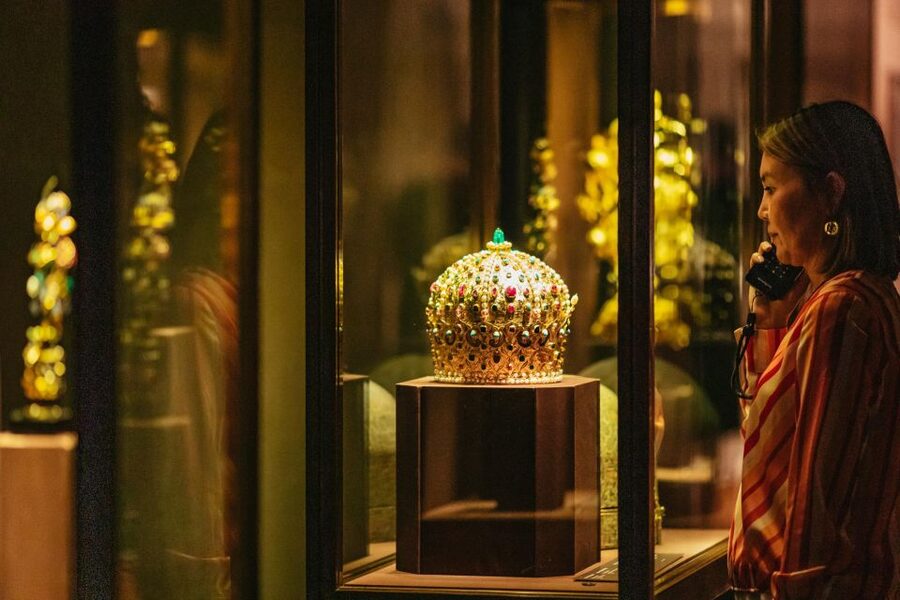
The treasury’s strangest objects are also among its most memorable. The Holy Lance is identified as dating from the 8th century and carries religious and legendary importance. Its value here is not just its age. It shows how sacred objects could become part of imperial identity.
The large agate bowl known as the Holy Grail brings another layer of legend. The bowl itself is an impressive object, and its traditional association makes it a useful reminder that medieval and imperial collections were shaped by belief as much as by artistic taste.
Then comes the unicorn horn. The object is presented as a horn of a unicorn, a description that may prompt a smile today, but it also reveals how people once understood rare materials and unfamiliar natural objects. In a royal treasury, an unusual object could gain prestige through the story attached to it.
These pieces prevent the visit from becoming a simple count of crowns and diamonds. You’ll find faith, myth, natural wonders, political theater, and family wealth all sharing the same rooms. That mixture is what makes the treasury more engaging than a standard jewelry exhibition.
Napoleon II’s cradle and the family story
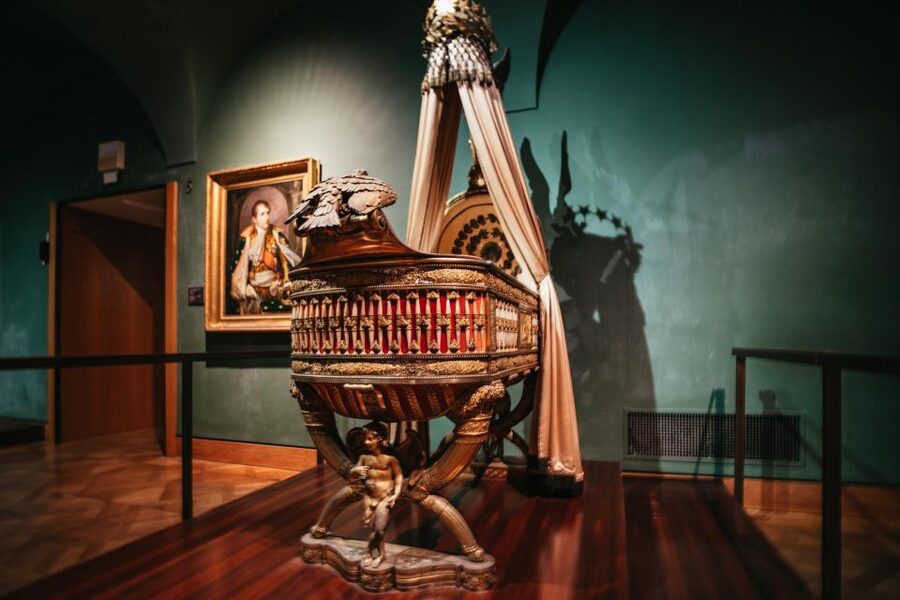
The cradle of the King of Rome, Napoleon II, is another unexpected object. It shifts the focus from imperial ceremony to dynastic succession and childhood. The title King of Rome belonged to Napoleon Bonaparte’s son, who was also known as the Duke of Reichstadt.
The cradle connects the Habsburg court with the Napoleonic era and shows how marriage and inheritance linked ruling families across Europe. It is also a welcome change of scale after the crowns and monumental regalia. You are reminded that behind the grand political story were children, marriages, births, and family hopes.
This is one reason I recommend reading the labels rather than simply walking from one dazzling case to the next. The collection becomes much more interesting when you connect the objects to dynastic events. Without that context, the treasury can look like a beautiful but disconnected storehouse.
Self-guided visit or guide
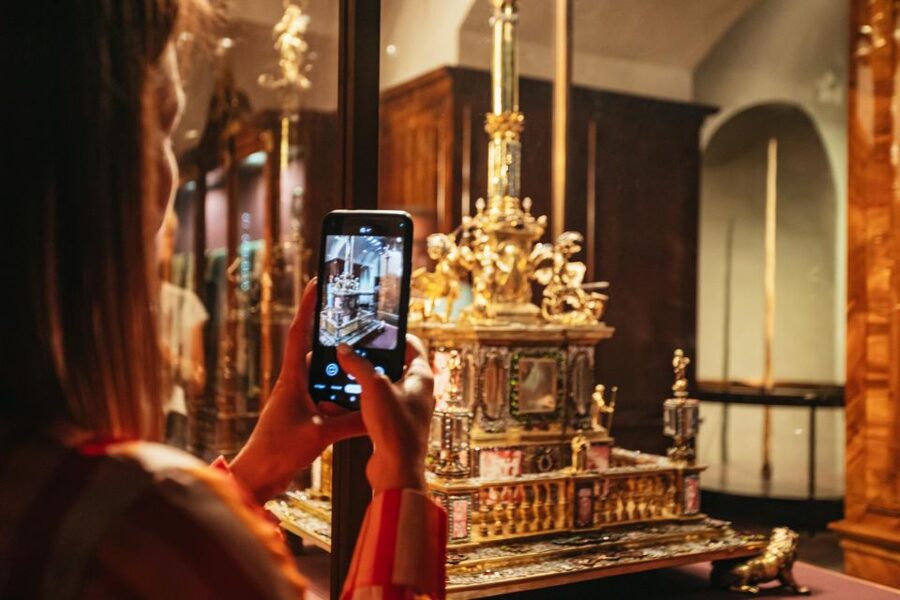
Admission does not include a guided tour, and you may visit independently or come with your own guide. That gives you freedom, but it also means the quality of the experience depends partly on how much background you want.
An audio guide may be available, but the booking information for this activity lists it as not included. Some visitors were given an audio guide at no extra charge, while others specifically found it worth obtaining. I would ask at the entrance rather than assume it is part of your ticket.
A guide can make a real difference here. The objects are visually strong, but the connections between Burgundy, the Holy Roman Empire, the Habsburgs, Sisi, and Napoleon II are not always obvious from the displays alone. Guides named Petee and Alex received especially warm praise for explaining the Habsburg family and answering questions. Those guides are not guaranteed, so treat their names as examples, not a promise.
If you use an audio guide, allow extra time. A quick visit can take about an hour, while listening to detailed explanations and examining each case may keep you inside for several hours. I prefer a middle path: see the crowns and unusual relics carefully, then use the guide for objects whose purpose or story is not immediately clear.
How long to spend inside
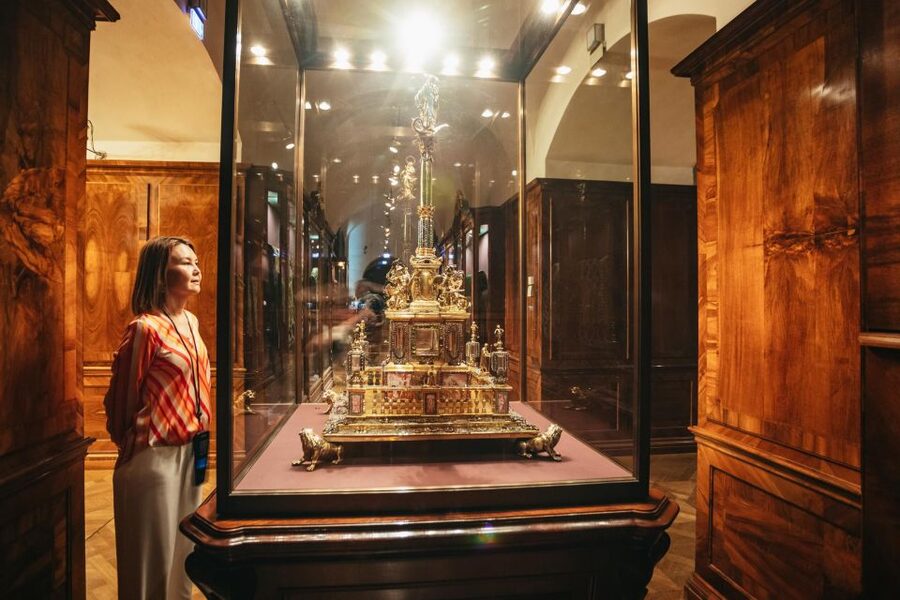
The advertised duration is one day because your admission is valid for the day, not because the treasury requires a full day. Most visitors can see the main collection in roughly one hour. Give yourself about 90 minutes if you want to read labels and pause at the major displays.
Two hours is a better plan if you want to use an audio guide, study the ceremonial clothing, or take a break and return. The staff can help you leave and come back, which is useful if the rooms begin to feel dense or if you are combining the treasury with other Hofburg sights.
Do not squeeze this visit into a narrow gap between timed attractions. The collection is not enormous, but it rewards patience. You may move quickly through the familiar crowns, then spend longer with a reliquary, key, tabard, or piece of jewelry that tells a quieter story.
Who will enjoy this visit most
I would recommend the Imperial Treasury to:
- Anyone interested in the Habsburgs, European monarchies, or royal ceremony.
- Visitors who enjoy jewelry, precious stones, religious art, and objects with unusual stories.
- Families with older children, especially since admission is generally free for those under 19.
- First-time Vienna visitors who want useful context for the wider Hofburg complex.
- Museum lovers who prefer a focused collection rather than a huge palace with many rooms.
It may be less satisfying if you want a lively, fully guided experience included in the ticket. The treasury is largely self-directed, and the layout can take a little effort to understand. It is also not the best choice if you have only a few minutes, since the ticket exchange and the displays both require time.
The small-group designation is limited to 10 participants, but this is not a conventional group tour with a guide leading you from room to room. If you want a personal explanation of the objects, bring your own guide or arrange a separate guided visit.
Is the $18 ticket good value?
At around $18, I consider the ticket good value for the quality and variety of the collection, especially if you care about imperial history. You are seeing objects that cannot be replaced by photographs or palace furniture: crowns worn in public ceremony, jewels tied to real dynasties, religious relics, and objects surrounded by centuries of legend.
The value drops if you expect skip-the-line access or a guided tour. The need to exchange a printed voucher can mean waiting, and the audio guide is not clearly part of the basic inclusion. You are paying for entry to the treasury, not a complete Hofburg experience.
Still, the visit compares well with many larger palace attractions because you can cover the main rooms in about an hour and a half. I also like that it offers more than the obvious highlights. The Habsburg story is in the emeralds and crowns, but it is also in the keys, tabards, cradles, and religious objects.
Practical tips before you go
Bring a printed voucher. This is the most important instruction, since a digital code may need to be exchanged for a paper ticket at the counter.
Check the availability and starting times before booking. The ticket is valid for one day, but the exact entry arrangements still matter when you are building a schedule around other Hofburg sights.
Ask about the audio guide when you arrive. It is listed as an extra, yet it has been supplied free in some cases. If it is available, it can add useful context, particularly for the dynastic and religious objects.
Allow at least one hour, and preferably 90 minutes. If you plan to listen to every explanation, allow considerably longer.
If you are visiting with a school group under 19, register through the museum booking department at [email protected]. Adult groups of more than 10 may qualify for one free guide place, provided the guide accompanies the group. Groups smaller than 10 do not receive a free guide place, and the guide is charged as a paying participant.
Should you book the Imperial Treasury?
Book it if you want to see the Habsburgs through their objects rather than only through palace rooms. The Austrian Imperial Crown, Holy Roman Empire regalia, Sisi’s jewelry, the giant emerald, Holy Lance, agate bowl, and unicorn horn give you a memorable cross-section of power, faith, family, and legend.
Skip it only if your Vienna schedule is extremely tight or you strongly prefer guided attractions. For most visitors interested in the Hofburg, the $18 admission is worthwhile, provided you bring the required printed voucher and allow enough time for the ticket counter and the collection itself.
FAQ
Where is the Imperial Treasury located?
The Imperial Treasury is in the Swiss Wing of Vienna’s Hofburg Palace, the oldest part of the palace complex.
How much does admission cost?
The listed price is $18 per person. Children and young people under 19 generally receive free admission.
Is a guided tour included?
No. The entrance ticket includes admission only. You may visit independently or bring your own guide. A guide is not included with the basic ticket.
Is an audio guide included?
The activity information lists the audio guide as not included. Some visitors received one free at the museum, so ask at the entrance about current availability and cost.
Do I need a printed ticket?
Yes. A printed voucher is required. A digital QR code may need to be exchanged at the ticket counter for an actual admission ticket.
How long should I allow for the visit?
You can see the collection in about one hour, but 90 minutes is more comfortable. If you use an audio guide and listen to detailed explanations, the visit may take several hours.
Just added around Vienna
- Private Tour from Vienna to Melk and Dürnstein★ 4.5 · 3 reviews
- Vienna: Johann Strauss 200th birthday anniversary exhibition★ 4.7 · 3 reviews
- Vienna Private Full Day Tour – Tickets to Schönbrunn & Lunch★ 5.0 · 3 reviews
- Private Salzburg Day Trip from Vienna★ 4.0 · 3 reviews
- Vienna: Entry Ticket Belvedere 21 & Contemporary Art★ 4.3 · 3 reviews
- Full-Day Private Trip from Vienna to Budapest★ 4.5 · 3 reviews
- Vienna by Night: Private Evening Food and Drink Tour★ 5.0 · 3 reviews
- 1.5 Hour Cinematic Style Portrait Photoshoot and Tour in Vienna★ 4.5 · 3 reviews
Hofburg & Imperial Vienna Tours, compared.

Skip-the-Line Sisi Museum, Hofburg and Gardens Tour
Read our review →
Skip-the-Line Hofburg and Empress Sisi Museum Tour
Read our review →
Combo Ticket: Kunsthistorisches Museum & Imperial Treasury
Read our review →
Imperial Treasury & New Hofburg Palace Combo Ticket
Read our review →
New Hofburg Palace Audio-Guided Tour & Entry Ticket
Read our review →
Skip-the-Line Sisi Museum, Hofburg and Gardens Tour Vienna
Read our review →
Browse the lists this tour appears in