
Reviewed · WALKING TOURS
Vienna: 1.5-Hour Underground Walking Tour
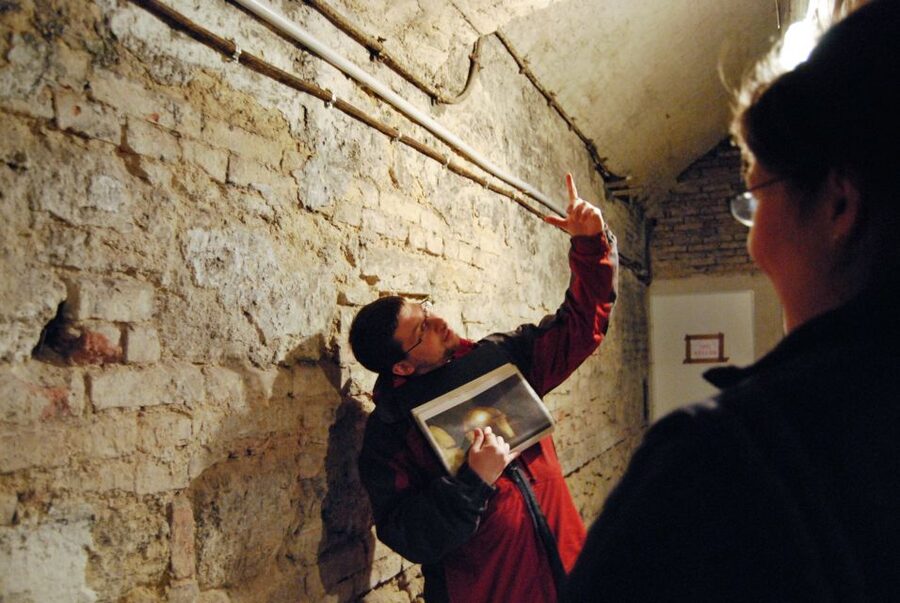
Vienna’s grandest sights rise above ground, but some of its best stories sit below it. This 100-minute walking tour begins at Michaelerplatz, where Roman remains, an old city wall, and a 17th-century cellar share the same patch of earth. Then it enters St. Michael’s Church, whose crypt holds more than 4,000 burials and remarkably preserved mummies.
I like the mix of archaeology and human stories, rather than a tour that only points at old stones. I also like the chance to see parts of Vienna you cannot find on your own, especially the Baroque crypt. The main drawback is clear: the tour is conducted in German, and while some guides offer short English explanations, there is no regular English-language version listed.
In This Review
- Key points to know
- Why Vienna’s underground deserves your time
- Starting at the Michaelerplatz excavation
- St. Michael’s Church and its Baroque crypt
- The additional cellars and underground rooms
- The German-language issue matters
- Is $32 a fair price?
- Timing, clothing, and practical limits
- Who will enjoy this tour most?
- How this compares with a standard Vienna walking tour
- Booking advice for a flexible Vienna schedule
- Should you book the Vienna Underground Walking Tour?
- FAQ
- Where does the Vienna Underground Walking Tour meet?
- How long does the tour last?
- What language is the tour conducted in?
- Does the tour visit St. Michael’s crypt?
- What can you see at Michaelerplatz?
- Are entrance fees included?
- Is the tour wheelchair accessible?
- Can I take photographs?
- Can I bring luggage or a large bag?
- Can I cancel the booking?
Key points to know
- Michaelerplatz excavation: See Roman remains, part of Vienna’s old wall, and a 17th-century cellar in the city center.
- St. Michael’s crypt: Enter a Baroque burial site with mummies and more than 4,000 people buried below the church.
- German-language guiding: The tour is in German, though guides have sometimes helped non-German speakers with brief English summaries.
- 100-minute route: Allow about an hour and 40 minutes, although one outing lasted close to three hours.
- Chilly, narrow spaces: Wear a sweater and leave large bags, luggage, cameras, and pets behind.
- Strong value at $32: Entrance fees are included, and the crypt alone may justify the cost for visitors interested in unusual Vienna history.
Why Vienna’s underground deserves your time
Vienna can feel like a city of palaces, museums, concert halls, and polished boulevards. This tour shifts your attention to the layers beneath that familiar imperial center. You walk through places tied to Roman Vienna, medieval development, early modern cellars, church burials, and the everyday business of building a city on top of older cities.
That change of scale is the real appeal. Above ground, Michaelerplatz is a busy central square surrounded by famous architecture. Below it, archaeological remains reveal that Vienna’s story did not begin with the Habsburgs. You get a compact lesson in how the city changed over two thousand years, with each basement and excavation adding another piece.
I would not book this as a replacement for a major museum or palace visit. It is better as a change of pace between those grander sights. The route is short enough to fit into a busy day, yet unusual enough to give you something very different from the usual Vienna checklist.
More walking tours in Vienna:
- Vienna: Guided Walking Tour of City Center Highlights
★ 4.7 · 4,989 reviews - Vienna: Vienna Central Cemetery Guided Walking Tour
★ 4.8 · 3,307 reviews - Vienna: Guided Walking Tour of City Highlights & Hidden Gems
★ 4.9 · 2,180 reviews
Starting at the Michaelerplatz excavation
Meet in front of the main entrance of St. Michael’s Catholic Church. This is a useful meeting point because the church and the archaeological excavation at Michaelerplatz are close together, but do not simply wander into the church expecting to find the group. The tour begins outside at the stated meeting place.
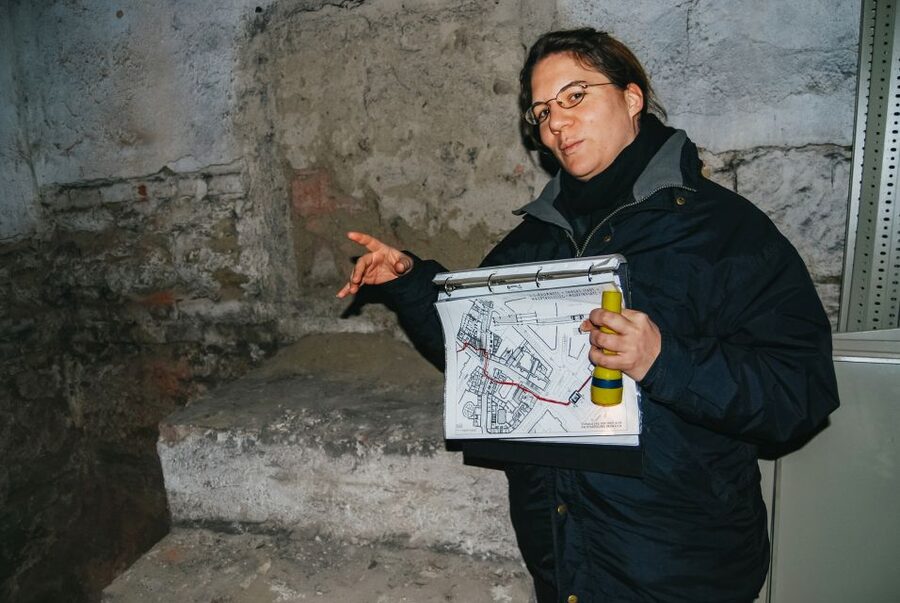
Michaelerplatz is one of the most revealing locations in central Vienna. Construction work exposed part of the old Roman city, along with a section of the former city wall and a cellar dating from the 17th century. The important point is not just that these remains are old. It is that they sit directly in the center of present-day Vienna, beneath a square you might otherwise cross without thinking about what lies below.
Your guide explains how the different periods relate to one another. The Roman remains show an early urban settlement. The later wall reflects a city concerned with defense and boundaries. The cellar points to a more practical side of Vienna, where buildings were altered, stored goods, and used their underground spaces over many generations.
This first stop gives the tour its framework. You are not simply visiting a crypt and then a few random basements. You are following the city downward through different periods.
St. Michael’s Church and its Baroque crypt
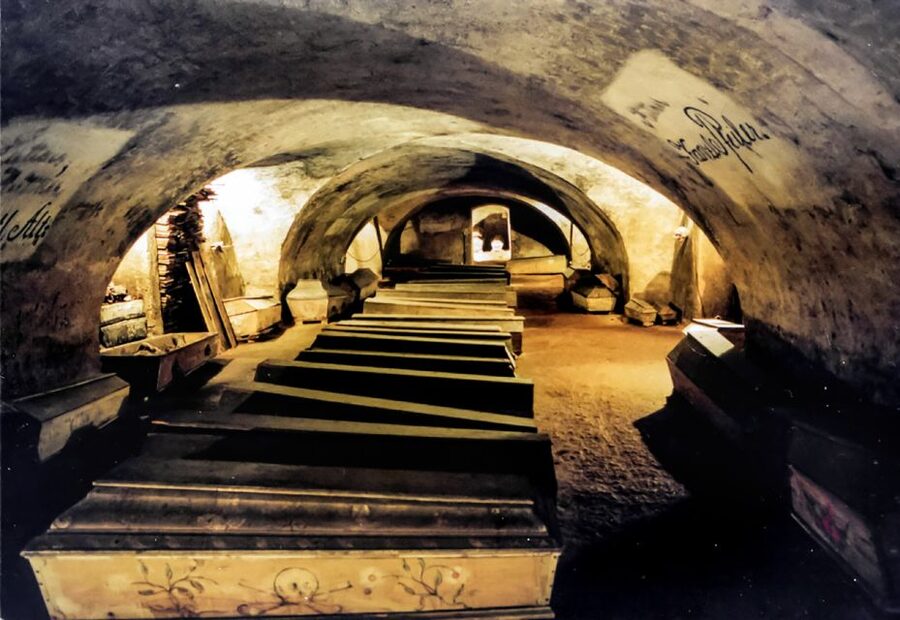
The emotional center of the tour is St. Michael’s crypt. More than 4,000 people are buried beneath the church, including prominent and wealthy Viennese citizens. The crypt is Baroque, but the experience is less about decorative church design than about the physical evidence of the people who were placed there.
The preserved mummies are the feature most likely to stay with you. They are not presented as a theatrical horror attraction. Instead, they offer a direct, unsettling look at past burial customs and the way underground conditions helped preserve bodies, clothing, and other details.
That makes the crypt especially useful for understanding Vienna as a lived city. Palaces tell you how rulers wanted to be seen. A burial site tells you how people dealt with death, status, faith, and memory. Here, the names and social position of those buried beneath the church connect the crypt to Vienna’s public life.
The space can be chilly, so bring a sweater even in warm weather. You should also be prepared for underground rooms rather than broad, well-lit galleries. The tour is not wheelchair accessible, and the setting may be uncomfortable if you dislike confined spaces or have trouble with stairs and uneven underground areas.
Photography is not allowed. That rule may disappoint anyone hoping to document the mummies, but it also keeps the visit focused and respectful. You will need to experience the crypt without relying on your phone camera.
The additional cellars and underground rooms
After the crypt, the route continues through several more basements. The supplied details do not promise a long tunnel network or extensive subterranean walking, so I would set your expectations correctly. This is an organized look at selected underground rooms, not an expedition through miles of tunnels.
That limitation is also part of the tour’s character. Vienna’s underground story is scattered through cellars, church spaces, excavations, and remnants beneath later buildings. The guide provides the connection between those places. Without that explanation, you might see an old wall or a dark room but miss why it matters.
One past participant wished the route went farther into the tunnels and included printed material. That is fair criticism if you are expecting a large archaeological complex. Another outing lasted nearly three hours, although the advertised duration is 100 minutes, so the actual pace may depend on the guide and the group.
The most useful way to approach this section is to value interpretation over distance. The tour gives you access to places you generally would not locate or enter by yourself. It is the stories and context that make the cellars worthwhile, not the number of rooms counted along the way.
A different side of Vienna on the same trip:
- Vienna: Vivaldi’s Four Seasons Concert in Karlskirche
★ 4.7 · 14,951 reviews - Vienna: Spanish Riding School Training
★ 3.9 · 9,281 reviews - Vienna: Skip-the-cashier-desk-line Giant Ferris Wheel Ride
★ 4.5 · 7,859 reviews - Vienna: Schönbrunn Palace & Gardens Skip-the-Line Tour
★ 4.7 · 7,739 reviews
The German-language issue matters
The tour is offered in German. This is the single most important booking consideration, especially because the subject depends on spoken explanation. You can still look at the ruins and crypt without understanding every word, but you will miss much of the historical context if you cannot follow German.
Some guides have made an effort to help. Christopher has been praised for an engaging, funny presentation, and Bridgett has led the tour with an historian’s approach and strong enthusiasm. Non-German-speaking participants have also received short English explanations from guides, sometimes using phone translation when the signal allowed it.
That help is welcome, but it is not the same as an English tour. Underground reception may be weak, and one participant understood only about 60 percent while relying on voice translation. If you speak some German, this may be a very good chance to practice while seeing something unusual. If you speak no German, book only if you are comfortable accepting a partial understanding.
The positive side is that the guides appear to bring personality to a subject that could otherwise feel dry. Descriptions of Christopher’s humor and passion, and Bridgett’s historical expertise, suggest that the guide makes a major difference. Still, those guides may not lead every departure, so you should not assume a particular person will be present.
Is $32 a fair price?
At $32 per person, the tour is not the cheapest short activity in Vienna. But the price includes entrance fees, and that changes the calculation. You are paying for access to several restricted underground areas, along with a guide who explains what you are seeing.
The crypt is the strongest value point. If you are interested in burial customs, church history, archaeology, or unusual places, the preserved mummies can justify much of the price by themselves. The Michaelerplatz excavation adds another worthwhile stop, especially because it is located in the middle of the city and shows a side of Vienna that is easy to overlook.
The value is weaker if you want a long, adventurous tunnel walk or a fully bilingual experience. You may see only a few underground rooms, and the German-only format can reduce what you take away. In that case, the tour becomes a visual visit with partial commentary rather than a full historical presentation.
For the right audience, I think the cost is reasonable. It is especially easy to fit into a central Vienna day because there are no transfers and the meeting point is at St. Michael’s Church. You can combine it with nearby sights without giving up half a day.
Timing, clothing, and practical limits
The listed duration is 100 minutes. Plan on roughly an hour and 40 minutes, but leave extra room if your schedule is tight because one group reported a tour lasting almost three hours. The difference may reflect a particularly detailed guide or a slower group.
Wear comfortable shoes and a warm layer. The underground spaces can be cold, and the route involves old interiors rather than a modern, climate-controlled attraction. Large bags and luggage are not allowed, so do not arrive with airport-sized baggage or a heavy shopping load.
Pets, smoking, and cameras are also prohibited. The no-camera rule is especially important because many people instinctively reach for a phone when they see preserved mummies. Put your phone away and listen to the guide.
The experience is not suitable for wheelchair users. The tour takes place in underground areas and is not wheelchair accessible. If you have other mobility concerns, the supplied information does not describe the exact number of steps or floor surfaces, so contact the provider before booking rather than guessing.
Group tours for 15 or more people follow different criteria. If you are organizing a school, company, or family group of that size, contact the provider to arrange another day or time.
Who will enjoy this tour most?
I would recommend it first to visitors who have already seen some of Vienna’s major surface sights and want a more unusual historical stop. It works well for people interested in archaeology, church history, death customs, old buildings, and the hidden practical spaces of a city.
It is also a good choice for repeat visitors. You may have walked past Michaelerplatz and St. Michael’s Church several times, yet never considered what is below them. The tour gives familiar central Vienna a new layer without requiring a train ride or a long journey outside the city.
Families with older children may find the mummies memorable, though the subject is serious and the underground setting is not designed as a children’s attraction. The tour’s suitability depends on the child’s interest and comfort with preserved human remains.
German speakers have the clearest advantage. Visitors with basic German may get a great deal from the guide’s stories and humor. English speakers can still enjoy the spaces, and a helpful guide may summarize key points, but you should not count on full English interpretation.
This is not the best pick for anyone who needs step-free access, wants to take photographs, or prefers a polished museum presentation with labels and printed material.
How this compares with a standard Vienna walking tour
A typical Vienna walking tour keeps you outdoors and uses the city’s major façades as its classroom. This one turns the city inside out. It is less about grand architecture and more about excavation, burial, construction, and the physical remains of earlier residents.
That makes it a strong companion to a regular city tour. After seeing imperial Vienna above ground, you can spend 100 minutes considering the Roman settlement, old defenses, church burials, and cellars that support the modern city below.
The experience also asks more from you than a standard sightseeing stop. You cannot take photos, the spaces may be cold, and the German commentary may be difficult. In exchange, the route feels less predictable and gives you access to places you would not normally enter alone.
I would not recommend choosing it simply because the word underground sounds adventurous. The tour is guided history, not a thrill ride. Its appeal comes from the contrast between central Vienna’s elegant public face and the quiet, cramped spaces beneath it.
Booking advice for a flexible Vienna schedule
You can cancel up to 24 hours before the tour for a full refund, and you can reserve now while paying later. Those options are useful if your Vienna plans are still moving around, especially since the tour is short and may fit into an open morning or afternoon.
Check the available starting times before committing. The exact departure schedule is not given here, and the advertised duration is the best planning guide. Arrive at the main entrance of St. Michael’s Catholic Church with enough time to identify the group before the tour begins.
Do not book this experience expecting an English departure. If English guiding is essential, ask the provider directly before paying. If you are willing to follow German, use translation help when possible, and accept that some underground areas may not have reliable data access.
Should you book the Vienna Underground Walking Tour?
Book it if you want unusual access to Vienna’s past, you are comfortable in underground spaces, and German guiding works for you. The Michaelerplatz remains and St. Michael’s crypt offer a memorable contrast to the city’s palaces and museums, while the $32 price includes admission.
Think twice if you need an English-language tour, step-free access, or a long tunnel adventure. The route covers selected basements and crypt spaces, not an extensive underground network, and the strongest part is the guide’s explanation.
For a German-speaking visitor, this is an easy recommendation. For an English speaker, it is a conditional one: worthwhile for the archaeology and mummies, but only if you can accept missing some of the commentary. Reserve it for a flexible part of your Vienna schedule, wear a sweater, and leave your camera and large bag at your accommodation.
FAQ
Where does the Vienna Underground Walking Tour meet?
Meet in front of the main entrance of St. Michael’s Catholic Church.
How long does the tour last?
The advertised duration is 100 minutes. One outing lasted almost three hours, so leave some extra time if your schedule is tight.
What language is the tour conducted in?
The live tour guide speaks German. Some guides have provided brief English explanations, but a regular English-language tour is not listed.
Does the tour visit St. Michael’s crypt?
Yes. The route includes the Baroque crypt beneath St. Michael’s Church, where more than 4,000 people are buried and preserved mummies can be seen.
What can you see at Michaelerplatz?
You can see part of the old Roman city, a section of the former city wall, and a cellar dating from the 17th century.
Are entrance fees included?
Yes, entrance fees are included in the $32 per-person price.
Is the tour wheelchair accessible?
No. The tour is not wheelchair accessible and is not suitable for wheelchair users.
Can I take photographs?
No. Cameras are not allowed on the tour.
Can I bring luggage or a large bag?
No. Luggage and large bags are not allowed. Pets and smoking are also prohibited.
Can I cancel the booking?
Yes. You can cancel up to 24 hours in advance for a full refund. The reserve-now, pay-later option is also available.
Just added around Vienna
- Private Tour from Vienna to Melk and Dürnstein★ 4.5 · 3 reviews
- Vienna: Johann Strauss 200th birthday anniversary exhibition★ 4.7 · 3 reviews
- Vienna Private Full Day Tour – Tickets to Schönbrunn & Lunch★ 5.0 · 3 reviews
- Private Salzburg Day Trip from Vienna★ 4.0 · 3 reviews
- Vienna: Entry Ticket Belvedere 21 & Contemporary Art★ 4.3 · 3 reviews
- Full-Day Private Trip from Vienna to Budapest★ 4.5 · 3 reviews
- Vienna by Night: Private Evening Food and Drink Tour★ 5.0 · 3 reviews
- 1.5 Hour Cinematic Style Portrait Photoshoot and Tour in Vienna★ 4.5 · 3 reviews
Walking Tours, compared.
Guided Walking Tour of City Center Highlights
Read our review →
Guided Walking Tour of City Highlights & Hidden Gems
Read our review →

Vienna Historic Center Small Group Walking Tour
Read our review →
Ghosts and Legends Guided Nighttime Walking Tour
Read our review →
Browse the lists this tour appears in