Reviewed · TOURS
Vienna: Time Traveling Virtual Reality Sightseeing Tour
Vienna’s past comes alive in six short virtual reality scenes on this unusual walking tour. You will watch an Ottoman attack, a plague-era city, Sisi and Franz Joseph on the road, 1920s opera life, and Soviet troops entering St. Stephen’s Square, then look around at the real places under your feet. I especially like the 360-degree headsets and the way the route links them to actual old-town sights. I also like that the tour gives first-time visitors a quick sense of how Vienna changed over centuries.
The main caution is that this remains a walking tour with brief VR stops, not a full-time headset attraction. Some scenes look a little rough, and bilingual guiding can slow the pace when English and German are mixed. Come for the clever history lesson and city orientation, not cutting-edge computer graphics.
In This Review
- Key points to know before booking
- Six centuries of Vienna in one city walk
- White Sunday in 1483
- The Ottoman siege of 1683
- Plague, music, and Augustin
- Sisi and Franz Joseph near the Hofburg
- Vienna at the Opera in the 1920s
- St. Stephen’s Square in the final month of World War II
- What the VR equipment adds, and where it falls short
- The guide and language setup
- Is $45 a fair price?
- Who should book this experience?
- Should you book the Vienna Time Traveling VR Tour?
- FAQ
- Where does the Vienna VR tour begin?
- Where does the tour finish?
- How long does the experience last?
- How far do you walk?
- Which languages are available?
- What is included in the price?
- Is the tour suitable for children?
- Can people with epilepsy take the tour?
Key points to know before booking
- Six time-travel scenes: See Vienna during a 1483 religious procession, the 1683 Ottoman siege, the plague, the age of Sisi, the 1920s, and World War II.
- A real old-town route: Walk 3.2 kilometers from Neuer Markt to the Albertina on flat ground.
- Two ways to listen: A live guide speaks English or German, while the audio guide is available in English, Spanish, Dutch, French, Italian, and Russian.
- Useful first-day introduction: The tour connects famous central places with the events that shaped them.
- Allow about 100 to 105 minutes: You walk between scenes, listen to explanations, and stop to use the headsets.
- Not for everyone: The tour is unsuitable for children under eight and people with epilepsy.
Six centuries of Vienna in one city walk
This experience works best as a short course in Vienna’s past. Instead of standing in front of a palace while a guide lists dates, you pause at the real setting and look through a headset at a recreated moment from another era.
The route covers about 3.2 kilometers over flat ground. That makes it manageable for most people who are comfortable walking for roughly an hour and a half, though you should still wear sensible shoes. The tour begins at Neuer Markt 6 and ends near the Albertina, so you finish in a useful central location rather than being returned to the starting point.
The advertised duration is 100 minutes, with the route details allowing about 105 minutes. That is long enough to get a proper orientation without giving up half a day. I would put this near the start of a Vienna visit, when you are still learning how the old town fits together.
At the meeting point, arrive 15 minutes early and look for the turquoise entrance. You receive virtual reality glasses and earphones for the audio guide. The equipment briefing matters because you will switch between ordinary walking, listening, and looking through the headset several times.
Other Vienna tours people book alongside this one:
- Vienna: Vivaldi’s Four Seasons Concert in Karlskirche
★ 4.7 · 14,951 reviews - Vienna: Spanish Riding School Training
★ 3.9 · 9,281 reviews - Vienna: Skip-the-cashier-desk-line Giant Ferris Wheel Ride
★ 4.5 · 7,859 reviews
White Sunday in 1483
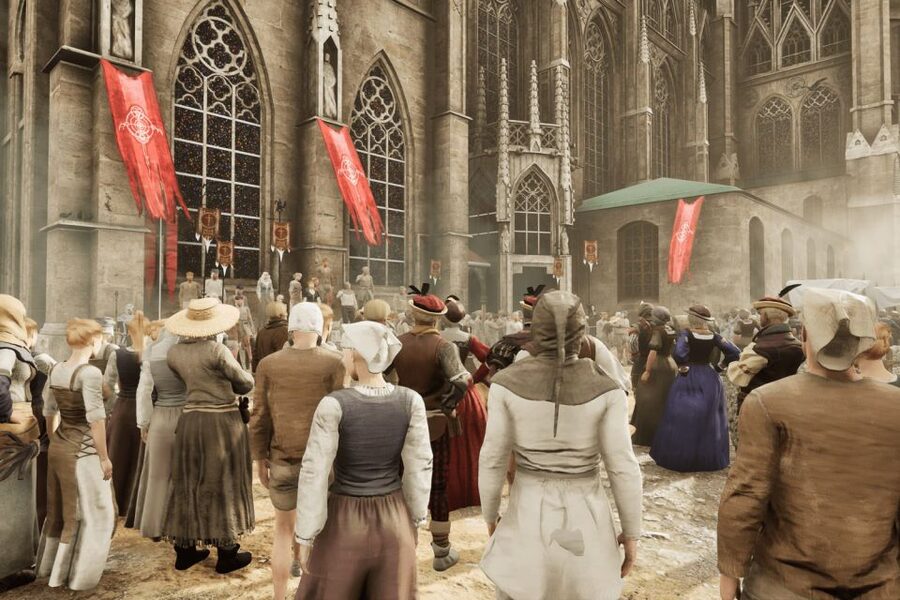
One of the earliest scenes takes you to White Sunday in 1483, when religious ornaments were brought out for public viewing. It offers a glimpse of a Vienna where faith was not just a private matter. Religious ceremony filled public streets and helped shape the city’s sense of identity.
This stop is useful because it puts the Gothic heart of Vienna into context. St. Stephen’s Cathedral is not simply an impressive building to photograph. It was part of public life, ceremony, and power.
The VR view gives you a better sense of the event than a paragraph in a guidebook can. You can look around rather than stare at a fixed image. Still, the effect depends on the quality of the recreation, and some people may find the visuals less sharp than expected from newer VR systems.
The Ottoman siege of 1683
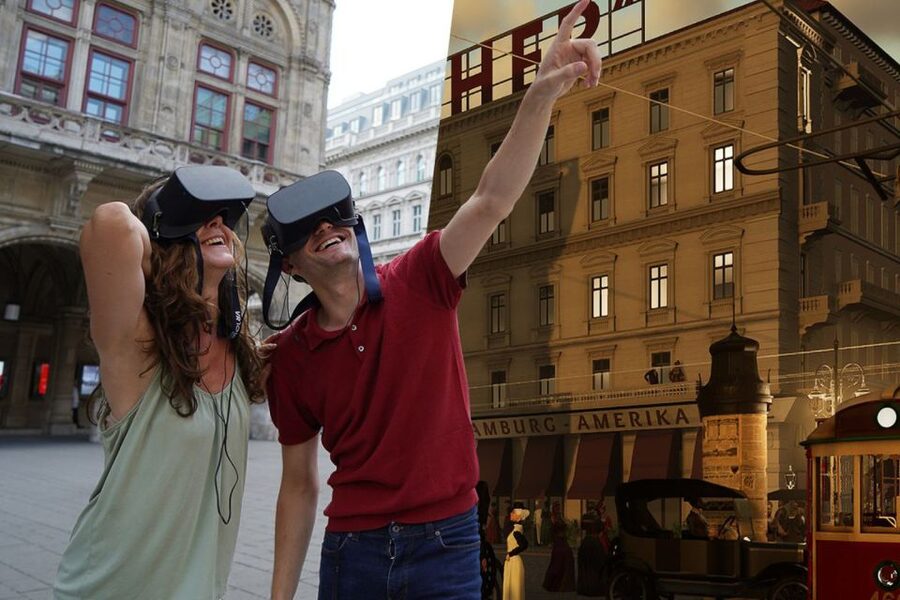
The next major scene places you in the second Ottoman siege of Vienna in 1683. You experience the threat from inside the city as the attack unfolds, with the old town serving as the setting rather than a distant backdrop.
This stop gives the walking route a strong sense of place. As you move through modern Vienna, you are reminded that the city was once a frontier under serious military pressure. The siege also helps explain why Vienna’s past is tied to wider European and Ottoman history, not just imperial palace life.
The scene is dramatic without requiring a battlefield excursion outside the city. You see history at the same location where the city’s defenses and survival mattered. If you prefer quiet museum displays, the attack sequence may feel intense. If you learn best through action, it is one of the tour’s more memorable moments.
Plague, music, and Augustin
The plague scene changes the mood. Vienna is shown during the disease outbreak that killed a large share of Europe, with the story of Augustin, a singer associated with humor and music during a grim period.
This is a worthwhile counterweight to Vienna’s polished imperial image. The city was not always grand palaces, concert halls, and elegant cafés. Disease, fear, and death were also part of daily life, and the Augustin story shows how humor could help people endure terrible conditions.
I like this section because it gives the tour some emotional range. You move from religious ceremony to war, then into public health disaster and popular culture. The headset can make the darkness of the period feel immediate, but the audio explanation is important here. Without the narration, a short visual scene would not convey much of the wider story.
A different side of Vienna on the same trip:
- Vienna: Schönbrunn Palace & Gardens Skip-the-Line Tour
★ 4.7 · 7,739 reviews - Vienna: Light of Creation Votive Church Immersive Light Show
★ 4.8 · 6,779 reviews - Vienna Spanish Riding School Guided Tour
★ 4.7 · 6,765 reviews - Vienna: Classical Concert in the World-Famous Musikverein
★ 4.6 · 6,673 reviews
Sisi and Franz Joseph near the Hofburg
At the Hofburg, the tour shifts to the late nineteenth century. On a sunny day, you see Empress Sisi and Emperor Franz Joseph II on a hunting trip as they pass along the road.
The scene adds a bit of playfulness to the program. You are asked to imagine standing close enough to the road to wink at the imperial couple. That small detail keeps the stop from feeling like a stiff royal portrait.
It also helps you read the Hofburg as a place of movement and daily imperial life, not just a collection of ceremonial rooms. You get a quick look at the people behind the titles and a sense of how the Habsburg image was presented in public.
Do not expect a long account of Sisi’s life or an inside visit to the palace. This is a brief visual episode tied to the route. If you want detailed imperial history, the Hofburg’s museums and exhibitions will take you much further.
Vienna at the Opera in the 1920s
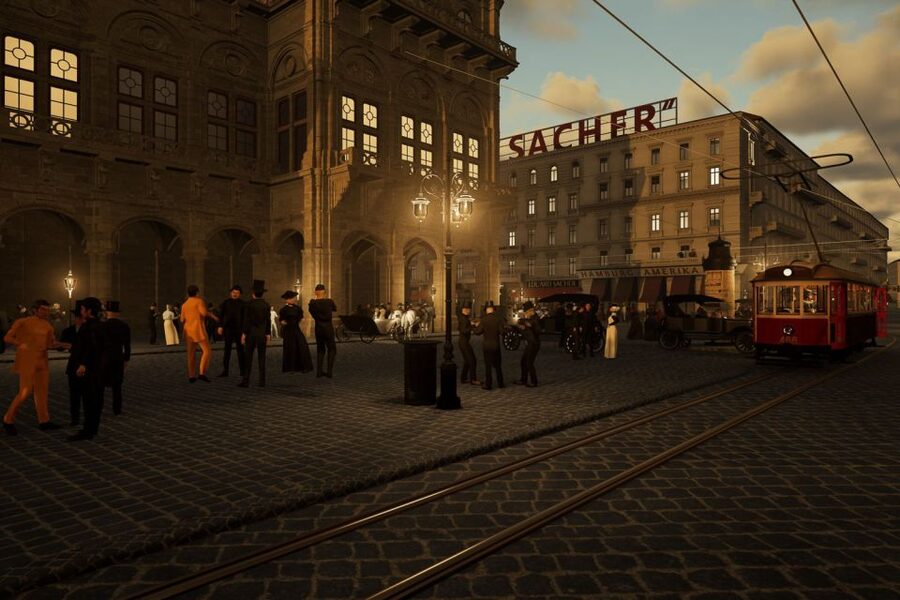
The opera scene moves into Vienna’s golden 1920s. You see people preparing for an evening performance near the Opera House, giving the period a social and theatrical setting.
This is a smart choice for a city tour because Vienna’s music culture is one of its defining features. The scene shows that attending an opera involved more than the performance itself. Clothing, arrival, anticipation, and public display were all part of the evening.
The quality of this scene has been a weak point for some visitors. The virtual setting can seem less lively than expected, and the view may not show enough dancing or period clothing to make the 1920s feel fully alive. I would treat it as an introduction to the era, not a complete recreation.
Even so, the stop helps connect the Opera House to the surrounding streets. If you later attend a performance or visit the area at night, you will have a clearer idea of how the building fits into Vienna’s cultural story.
St. Stephen’s Square in the final month of World War II
The final scene returns to St. Stephen’s Square during the last month of World War II. You witness the cathedral burning and the Soviet army driving the last German soldiers out of the city.
It is a powerful ending because the tour returns to a place you have already encountered in an earlier period. The same square changes from a medieval religious setting to a scene of wartime destruction and political change.
This moment also makes clear that Vienna’s historic center is not frozen in the past. Buildings survived, burned, and were rebuilt. The city’s current appearance carries the marks of conflict as well as imperial ceremony.
The subject is serious, so this is not a lighthearted final attraction. But it gives the tour a clear sense of how recent Vienna’s most painful past can be. You finish with a better understanding of why the city looks both old and modern at the same time.
What the VR equipment adds, and where it falls short
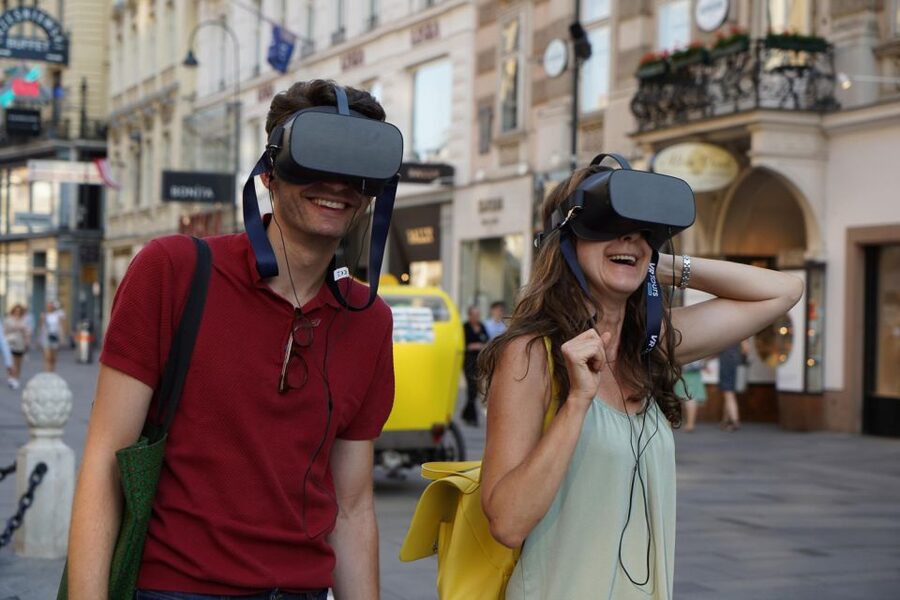
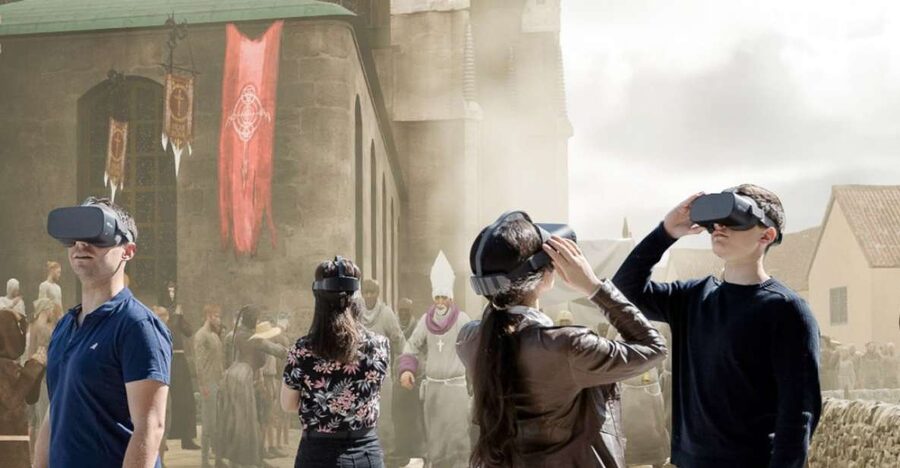
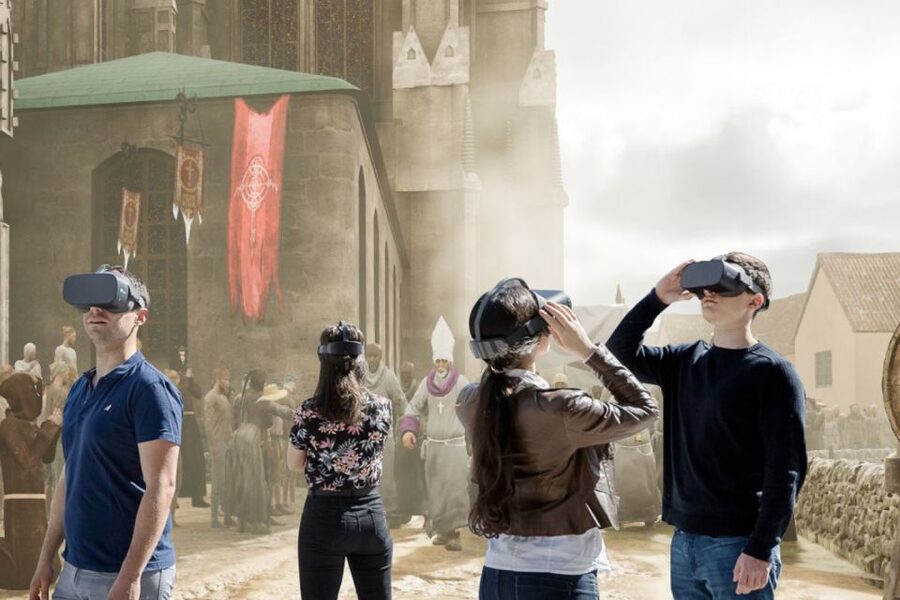
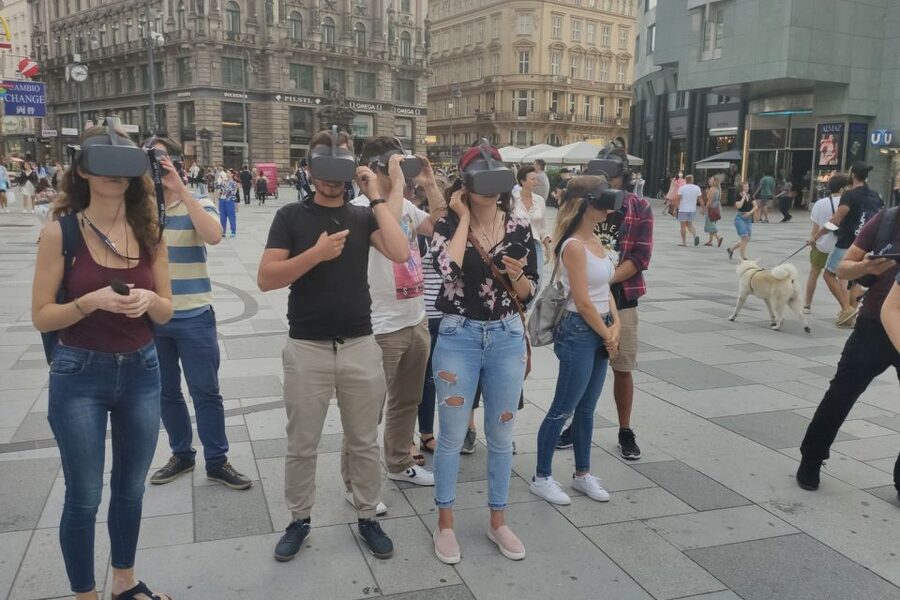
The headsets are the reason to choose this tour over an ordinary walking route. A 360-degree view lets you turn your head and inspect the scene around you. That is more engaging than a flat photograph, especially when the historical action takes place in a square or along a street.
The technology also solves a basic problem in city tours: the present-day view can hide the past. Modern traffic, shops, signs, and restored buildings do not always reveal what happened in the same location. VR places the missing layer back in front of you.
But you should set your expectations correctly. The images can be slightly blurry, with indistinct faces and a dated visual style. One scene may feel more like an early VR production than a modern video game. The historical idea is stronger than the image quality.
Most of the tour is also spent walking and listening. You do not wear the headset continuously. You stop at selected places, put it on for a scene, remove it, and continue with the guide. That rhythm works well for people who want both a city walk and a technology-based attraction, but it may disappoint anyone expecting 100 minutes of constant VR.
The guide and language setup
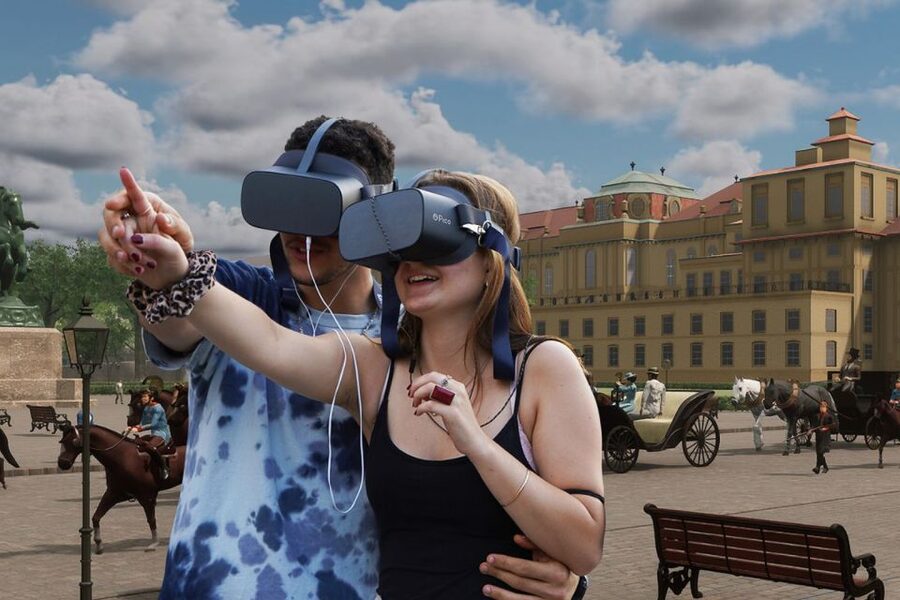
The live guide speaks English or German. The audio guide adds English, Spanish, Dutch, French, Italian, and Russian, which makes the tour accessible to a wider range of visitors.
The live explanation is especially helpful when the VR scene is brief or visually unclear. Guides such as Julian and Dr. Reiner have been singled out for clear explanations, help with the equipment, and fluent English and German guiding. The guide also keeps the group moving through central Vienna rather than leaving you alone with the headset.
If a group combines English and German, explanations may take longer and the transition between languages can feel awkward. If your departure includes both languages, expect a little less pace. The audio system helps, but the setup is not as smooth as having fully separate language groups.
I would choose the language you understand best and pay close attention during the equipment briefing. The headsets and earphones are included, and the guide explains how to use them.
Is $45 a fair price?
At $45 per person, this is not the cheapest way to see central Vienna. A normal walking tour can cost less, and many of the places on the route are free to view from the street.
The value comes from combining three things: a guided old-town walk, historical storytelling, and six VR reconstructions. If you are visiting Vienna for the first time and want a quick overview of the city’s long story, the price can make sense. You are paying for a structured introduction, not just transport between attractions.
I would be less enthusiastic about the value if you already know Vienna well or have visited several history museums. The scenes are short, and the graphics are not at the latest technical level. You may feel that the walking and audio portions provide more of the experience than the headsets themselves.
The strongest value comes when you use the tour as a starting point. Afterward, you can decide which subjects deserve more time: the Hofburg and Sisi, the Opera, St. Stephen’s Cathedral, or Vienna’s wartime past.
Who should book this experience?
I recommend it most for first-time visitors, families with older children, and anyone who wants a city introduction that is more active than a standard lecture. Children must be at least eight years old, and the tour is not suitable for people with epilepsy.
It also suits you if you enjoy connecting a real street corner to an earlier moment. The route is flat, and the finish near the Albertina makes it easy to continue sightseeing afterward.
You may want another tour if you prefer long, detailed explanations at each site, polished modern VR graphics, or a quiet museum setting. People sensitive to headsets should also think carefully before booking. The tour can be canceled in poor weather, especially heavy rain or storms, because conditions may change quickly.
Free cancellation is available up to 24 hours before the start, and you can reserve now and pay later. That flexibility is useful if rain is likely, though a last-minute weather decision may still affect your plans.
Should you book the Vienna Time Traveling VR Tour?
Book this tour if you want a lively first look at Vienna and like the idea of seeing the past at the exact places where it happened. The best parts are the 360-degree historical scenes, the walk through the old town, and the way the six episodes move from medieval ceremony to twentieth-century war.
Skip it if your main goal is state-of-the-art VR or a detailed specialist tour. The visuals can look dated, and bilingual groups may move more slowly.
For most first visits, I would place it on day one or day two. It gives you names, places, and story threads to follow for the rest of your stay. With a 4.6 rating from 672 reviews, a $45 price, and a manageable route, it is a solid choice for curious visitors who want Vienna’s history presented in a fresh format.
FAQ
Where does the Vienna VR tour begin?
It begins at Neuer Markt 6 in Vienna. Look for the turquoise entrance and arrive 15 minutes before the scheduled start.
Where does the tour finish?
The tour finishes at the Albertina.
How long does the experience last?
The advertised duration is 100 minutes. The route information allows about 105 minutes, so plan for roughly one hour and forty minutes to one hour and forty-five minutes.
How far do you walk?
The route covers 3.2 kilometers over flat terrain.
Which languages are available?
The live guide speaks English or German. The included audio guide is available in English, Spanish, Dutch, French, Italian, and Russian.
What is included in the price?
Virtual reality glasses and earphones for the audio guide are included. Food and drinks are not included.
Is the tour suitable for children?
Children under eight years old cannot join the tour.
Can people with epilepsy take the tour?
No. The experience is not suitable for people with epilepsy because it uses virtual reality equipment.
Just added around Vienna
- Private Tour from Vienna to Melk and Dürnstein★ 4.5 · 3 reviews
- Vienna: Johann Strauss 200th birthday anniversary exhibition★ 4.7 · 3 reviews
- Vienna Private Full Day Tour – Tickets to Schönbrunn & Lunch★ 5.0 · 3 reviews
- Private Salzburg Day Trip from Vienna★ 4.0 · 3 reviews
- Vienna: Entry Ticket Belvedere 21 & Contemporary Art★ 4.3 · 3 reviews
- Full-Day Private Trip from Vienna to Budapest★ 4.5 · 3 reviews
- Vienna by Night: Private Evening Food and Drink Tour★ 5.0 · 3 reviews
- Semi-Private Tour: Central Europe &Balkans from Vienna to Athens★ 5.0 · 3 reviews
Tours, compared.

Schönbrunn Palace & Gardens Skip-the-Line Tour
Read our review →
Skip-the-Line Sisi Museum, Hofburg and Gardens Tour
Read our review →
Skip-the-Line Schönbrunn Palace & Gardens Tour
Read our review →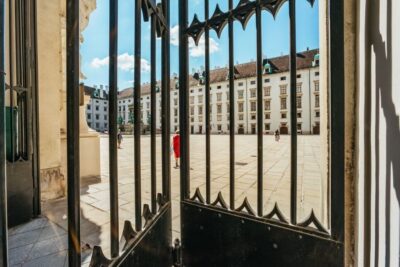
Guided Walking Tour of City Center Highlights
Read our review →
Bus & Schönbrunn Palace Skip-the-Line Guided Tour
Read our review →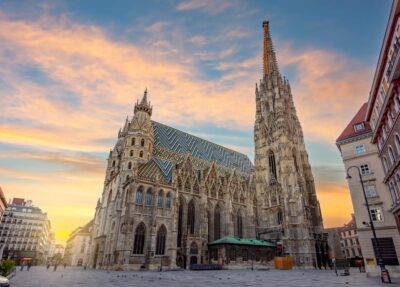
Guided Walking Tour of City Highlights & Hidden Gems
Read our review →