
Reviewed · WALKING TOURS
Private Introduction to Vienna Walking Tour
Vienna’s story comes in layers, and this private walk puts many of them in one well-planned route. In three hours, you move from the Hofburg and the Habsburg burial churches to Ottoman siege walls, imperial boulevards, the Belvedere, Naschmarkt, and the MuseumsQuartier. It is a brisk introduction to a city that can otherwise feel spread across several districts.
I like the private format, since your guide can adjust the pace and explain the parts of Vienna that interest you most. I also like the unusual focus on Habsburg burial customs: the rulers’ bodies, hearts, and entrails rest in different churches, a strange but memorable key to Vienna’s imperial past.
The main consideration is the ambitious route. You cover a lot of ground in about three hours, mostly on foot, and food, drinks, and attraction admission are not included. If you want long interior visits, this is not the right format. If you want a strong first look at Vienna, it works well.
In This Review
- Key points at a glance
- Start at Cafe Hawelka and meet Vienna head-on
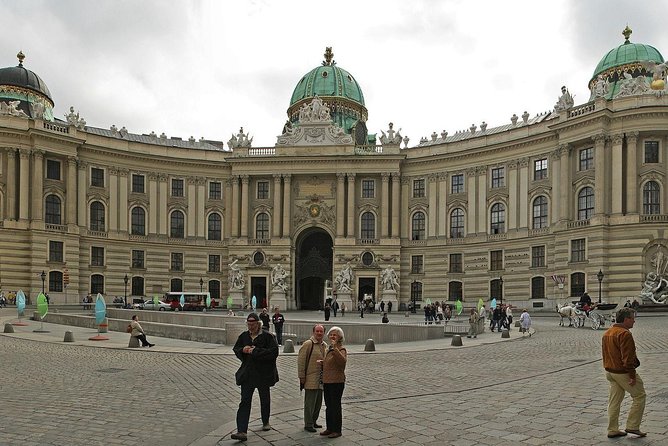
- Michaelerplatz and the Hofburg’s imperial center
- Kohlmarkt, Graben, and the story of imperial Vienna
- Three churches and one unusual Habsburg tradition
- From medieval walls to the Ringstrasse
- Schwarzenbergplatz and Vienna’s wartime memory
- Belvedere, Karlsplatz, and the Secession building
- MuseumsQuartier and Maria Theresien Platz
- What the private guide adds
- Is $566.25 a fair price?
- Practical details before you book
- Who should book this Vienna walk?
- FAQ
- How long is the Private Introduction to Vienna Walking Tour?
- Where does the tour usually begin?
- How early should I arrive?
- Is hotel pickup available?
- Is the tour private?
- Is the tour offered in English?
- Does the price include food and drinks?
- Does the tour include attraction admission?
- What is the price for the group?
- Can I cancel for a full refund?
Key points at a glance
- Three hours with only your group: A private historian guide leads your party, with up to 10 people permitted.
- A useful first-day route: The walk links the Hofburg, Stephansdom, Capuchin Church, Ringstrasse, Belvedere, Karlsplatz, and MuseumsQuartier.
- Habsburg burial customs: You learn why the dynasty’s bodies, hearts, and entrails were placed in separate Vienna churches.
- Architecture from many eras: The route includes Adolf Loos’s Loos House, Baroque churches, grand Ringstrasse buildings, and the gold-domed Secession building.
- A personal pace: Guides including Katarina, Selin, Biljana, and Else have been praised for warmth, storytelling, careful pacing, and custom planning.
- Best value for a small group: At $566.25 for up to 10 people, the cost works much better for a family or group than for one or two people.
Start at Cafe Hawelka and meet Vienna head-on
The usual meeting point is Cafe Hawelka at Dorotheergasse 6, in Vienna’s first district. You meet your guide 15 minutes before the scheduled start unless hotel pickup has been arranged in advance. The tour is offered in English, and confirmation arrives when you book.
Starting near the Hofburg is smart. Vienna’s old center is compact enough to explore on foot, but its history can feel confusing at first. The Hofburg is not simply another palace. It was the Habsburg seat of power from the thirteenth century onward, and its presence explains much of the city’s ceremonial center.
Your guide is an historian, not just someone pointing out attractive buildings. The emphasis is on how power, religion, architecture, war, and modern city life overlap. That gives you a useful framework for the rest of your Vienna visit.
The private setup matters here. A group of two can ask detailed questions about the Habsburgs, while a family can keep the pace moving and focus on the most engaging stories. Recent guide feedback gives you several names to request if available: Katarina, Selin, Biljana, and Else. Else was praised for meeting promptly at a hotel, moving efficiently, and covering plenty without making the walk feel rushed. Biljana was especially appreciated for her storytelling and an easy pace for a family with young adults.
More walking tours in Vienna:
- Vienna: Guided Walking Tour of City Center Highlights
★ 4.7 · 4,989 reviews - Vienna: Vienna Central Cemetery Guided Walking Tour
★ 4.8 · 3,307 reviews - Vienna: Guided Walking Tour of City Highlights & Hidden Gems
★ 4.9 · 2,180 reviews
Michaelerplatz and the Hofburg’s imperial center
Michaelerplatz gives you a strong first view of Vienna’s old power center. The Hofburg dominates the square, and from here you can begin to understand how the Habsburg court shaped the city around it.
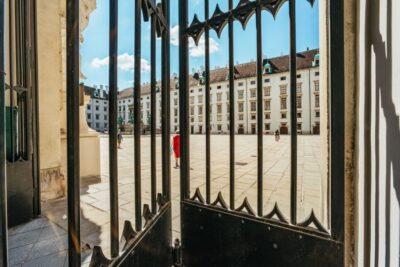
The square also introduces a useful contrast. Clockwise from the palace is the Loos House, designed by Austrian architect Adolf Loos in the early twentieth century. Its green and gray exterior is far less decorative than the imperial buildings nearby. That difference gives your guide an opening to discuss how Vienna moved from royal display toward modern architecture.
This is one of the better parts of the tour for architecture-minded visitors. You are not looking only at famous façades. You are comparing styles within a few steps of each other, from the palace’s imperial presence to Loos’s stripped-down design.
The drawback is that a three-hour walk cannot provide a full visit to the Hofburg complex. Think of this stop as an orientation and exterior explanation, not a palace museum tour. If you want the Imperial Apartments, the Sisi Museum, or the Spanish Riding School, you will need separate time.
Kohlmarkt, Graben, and the story of imperial Vienna
From Michaelerplatz, the walk follows Kohlmarkt and the Graben, now among central Vienna’s most fashionable shopping streets. The setting is polished, but the route is not limited to shopping and grand storefronts.
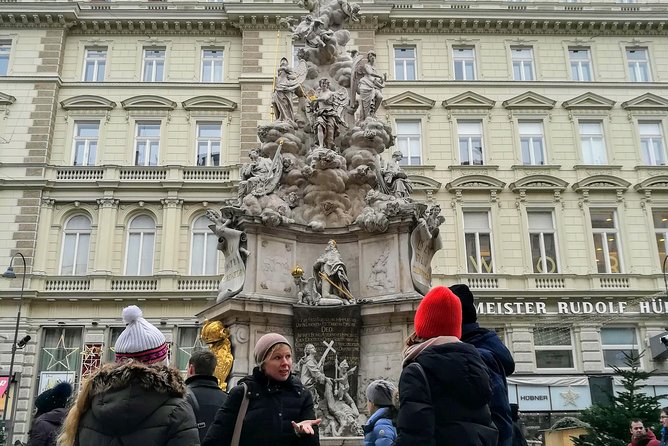
The Graben brings together several themes: a plague column, Baroque churches, large buildings from different periods, and the approach to Stephansdom. The plague column is a reminder that Vienna’s past includes fear and hardship as well as court ceremony. Its elaborate form also shows how religious art was used to express public gratitude and power.
You will see why the Graben works so well as a teaching ground. In a short stretch, you can discuss plague, Baroque style, urban planning, commerce, and the Habsburg court. A private guide can pause when a detail catches your eye instead of following a fixed group schedule.
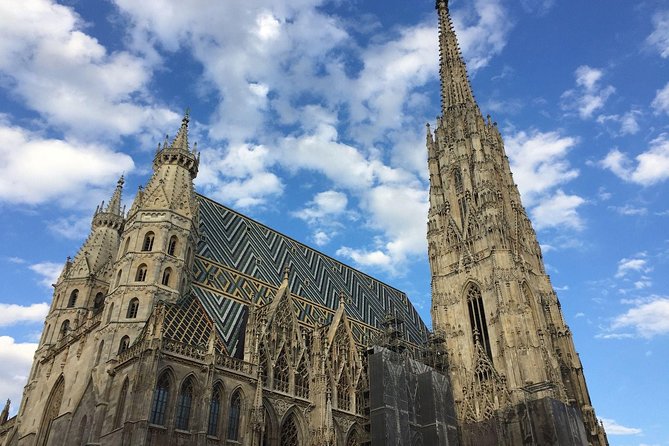
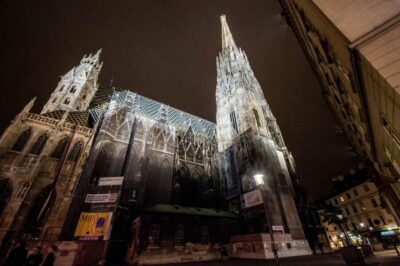
Stephansdom is the visual anchor of this part of town and Austria’s national architectural icon. Even if your walk does not include a long interior visit, your guide can place the cathedral in the larger story of Vienna. It is both a religious building and a symbol of the city itself.
Allow yourself time to return to Stephansdom later if you want a closer look. The tour gives you context, but its wide route means you should not expect a detailed examination of every monument.
Three churches and one unusual Habsburg tradition

One of the most memorable sections concerns the Habsburgs’ tripartite burial tradition. Their bodies, hearts, and entrails were placed in different churches, creating three separate links between dynasty and city.
St. Stephen’s Cathedral is associated with the imperial entrails. Nearby, the Capuchin Church contains centuries of sarcophagi belonging to Vienna’s rulers. St. Augustine’s Church holds silver urns containing the hearts of the Habsburgs.
This is an excellent example of why a guide adds value. Without explanation, you might see three churches as separate religious landmarks. With the story connected, they become part of one unusual royal ritual. It also gives you a more human sense of the dynasty. The Habsburgs were not only names in a history book. Their remains are physically distributed through the center of Vienna.
The churches also show different moods. The Capuchin Church is linked to its rows of sarcophagi and has a more intimate, solemn character. St. Augustine’s Church is tied to the silver heart urns. Stephansdom is much larger and more public in its role.
You should confirm with your guide what interior access is possible on your date. The supplied details promise a guided walk, not admission to every church. Food, drinks, and entry tickets are not included.
A few more Vienna tours worth weighing up
- Vienna: Private Walking Tour with a Local Guide
★ 4.6 · 1,420 reviews - Vienna: Private Walking Tour with a Guide
★ 4.7 · 962 reviews - Vienna: Wine Tasting Experience in a Private Wine Cellar
★ 4.8 · 413 reviews - Private Day Tour Trip Salzburg Hallstatt and Melk from Vienna
★ 5.0 · 388 reviews
From medieval walls to the Ringstrasse
Along the edge of the inner city, you examine remnants of the old city walls. These defenses date from the twelfth century and helped protect Vienna during two Ottoman sieges, in 1529 and 1683.
The walls were eventually removed, and their place was taken by the Ringstrasse. This grand circular boulevard became Vienna’s answer to the broad avenues of Paris. The change tells you a great deal about the city’s ambitions. Medieval defense gave way to imperial display, public buildings, monuments, and open avenues.
This is where the walk shifts from old Vienna to nineteenth-century Vienna. Instead of treating the Ringstrasse as a pretty drive, the guide explains why it was built and what it replaced. You begin to see the city as a series of decisions, not just a collection of historic buildings.
Because the tour is on foot, you get a better feel for the changing scale. The narrow inner-city streets and broad boulevard do not feel like the same town. That contrast is part of the pleasure.
Still, the route requires steady walking. Most people can participate, according to the supplied information, but the itinerary is not designed as a slow, seated sightseeing tour. Wear comfortable shoes and keep the pace in mind when deciding whether to book it early in your stay.
Schwarzenbergplatz and Vienna’s wartime memory
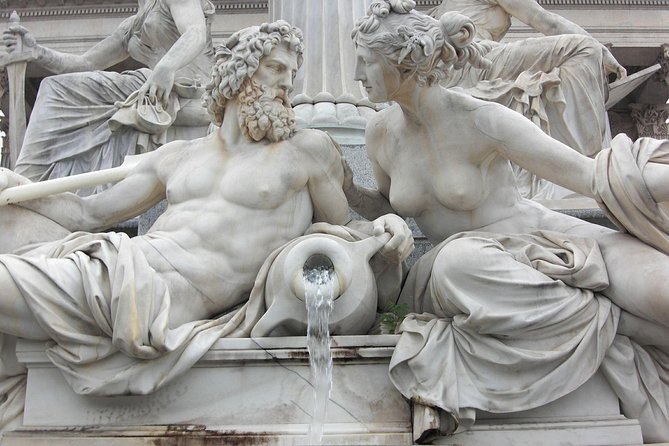
The walk continues to Schwarzenbergplatz, where a large fountain and memorial to the Russian soldiers who died liberating Vienna from the Nazis dominate the area. This is one of the more politically charged points on the route.
The square also sits near many of Vienna’s embassies. That makes it a useful place to discuss the city beyond its imperial past, including Austria’s role in modern European political and economic life.
The memorial can prompt difficult questions about the end of the Second World War and Vienna’s postwar identity. A private guide is particularly useful here because you can ask for context rather than simply passing a monument with a quick date.
This stop adds balance to the tour. The route is full of palaces, churches, and grand avenues, but Vienna’s twentieth-century story matters just as much. The city’s identity was shaped by war, occupation, political change, and the effort to live with its past.
Belvedere, Karlsplatz, and the Secession building
A short detour takes you toward Belvedere Palace before the route heads back toward Karlsplatz. The information provided does not promise entry to the palace, so think of this as a look at the setting and architecture rather than a full palace visit.
Belvedere is an important addition because it broadens the story beyond the Hofburg. The Habsburg world was not centered on one building alone. Vienna’s palaces, gardens, churches, and public avenues formed a connected setting for court life and imperial authority.
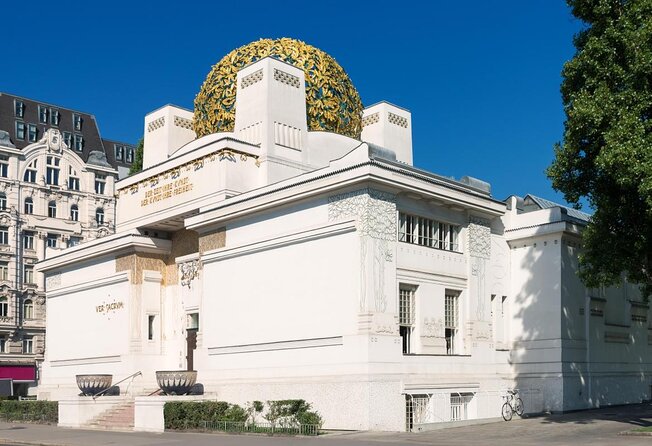
Karlsplatz brings another change in architectural mood. Here you get a view of the Secession building, one of Vienna’s gold-domed modern landmarks. Its dome gives the building an unmistakable profile and provides another chance to compare older imperial forms with the artistic movements that followed.
The route also takes in Naschmarkt. The supplied details do not promise a food stop or tasting, and food and drinks are excluded, but the market helps you see present-day Vienna as a lived-in city rather than a museum of imperial monuments. If you want to browse or eat there, plan to return after the tour.
MuseumsQuartier and Maria Theresien Platz
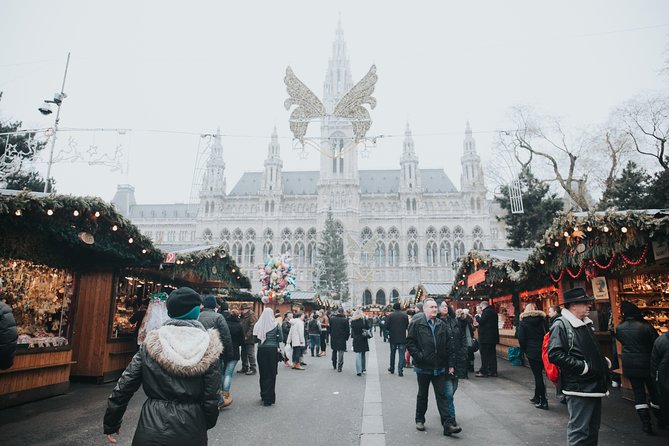
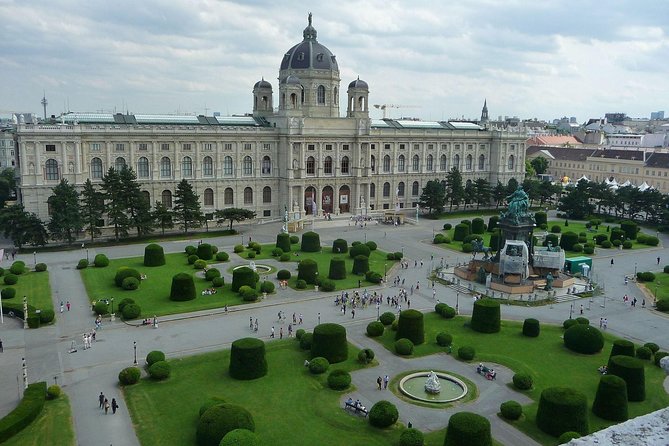
The final section weaves through MuseumsQuartier and Maria Theresien Platz, an area with Vienna’s largest concentration of museums. This ending is well chosen because it shifts the focus from royal history to the city’s cultural life today.
Maria Theresien Platz also keeps the Habsburg thread in view. By this point, you have seen the dynasty’s palace, churches, burial customs, military history, and urban legacy. The museum district then points toward Vienna’s present-day cultural, political, and economic direction.
This is valuable orientation for the rest of your trip. You can decide which museums deserve a return visit, which districts you want to explore on your own, and where Vienna’s old center gives way to newer cultural spaces.
The end point is listed simply as Vienna, Austria, so you should clarify the exact finishing spot with the provider if you need to meet someone or reach a timed reservation. The walk begins at Cafe Hawelka unless hotel pickup has been arranged, but no detailed end logistics are provided.
What the private guide adds
The strongest part of this experience is the guide’s role in shaping the walk. You are not limited to a large group’s fixed questions or pace. The guide can spend more time on architecture, dynastic politics, religious customs, or modern Austria, depending on what catches your attention.
The guide names connected with this experience include Katarina, Selin, Biljana, and Else. Selin was praised for building a customized family route with a warm manner and careful attention to detail. Biljana was praised for storytelling and a pace that worked for adults in their twenties. Else was described as friendly, energetic, efficient, and able to cover a great deal without making the experience feel hurried.
That combination is important. A private tour is not automatically good simply because it is private. The value comes from a guide who can read the group and keep the history clear. The available feedback points to precisely those qualities: personal planning, warmth, strong storytelling, and sensible pacing.
You can also use the first morning strategically. One family chose the tour at the start of its Vienna stay, which is a smart approach. After three hours, you have a map in your head and a better idea of which places deserve a longer return visit.
Is $566.25 a fair price?
The listed price is $566.25 per group of up to 10 people. For a full group, that works out to about $56.63 per person. For two people, the same tour costs about $283.13 per person, so the value depends heavily on group size.
For a family or group of friends, the price can make sense. You receive three hours with a private historian guide, hotel pickup may be arranged, and the group can move at its own pace. Compared with booking several separate admissions and a private guide, the cost may be reasonable for a special first-day orientation.
For one or two people on a tight budget, it is a major expense. You are paying for private attention and planning, not for included meals, museum tickets, or a full-day excursion. If you mainly want a short introduction to Stephansdom and the Hofburg, a less expensive group walk may suit you better.
The tour earns its price best when you use the guide actively. Ask questions, mention your interests, and request help choosing what to see afterward. A private three-hour walk should leave you with more than photographs. It should help you spend the rest of your time wisely.
Practical details before you book
The experience lasts about three hours and is offered in English. It is a private activity, so only your group participates, with a maximum group size of 10.
Pickup is offered, but hotel pickup must be arranged. Otherwise, meet at Cafe Hawelka, Dorotheergasse 6, 1010 Vienna, 15 minutes before the start time.
Most people can participate, but this is a substantial walking itinerary. Since there are no included food or drink stops, eat beforehand or plan something afterward. The route passes Naschmarkt, but the tour does not include tastings.
Free cancellation is available if you cancel at least 24 hours before the local start time. Cancellations or changes made less than 24 hours before the start are not accepted for a refund.
Who should book this Vienna walk?
You should consider it if you are visiting Vienna for the first time and want the city’s major themes explained in one sitting. It also suits families, couples, and small groups who value a guide’s full attention.
History and architecture fans will get the most from the links between the Hofburg, Loos House, the Habsburg churches, old fortifications, Ringstrasse, Belvedere, and Secession building. The route is especially useful if you like understanding why a city looks the way it does.
I would be cautious about booking it if you want long museum visits, extensive palace interiors, or a relaxed cafe-and-shopping morning. The route covers a lot, and the price is steep for a very small party.
For a family or group of friends, especially on your first full day, I think this is a strong choice. Book it if you want a clear introduction to Vienna, a private pace, and memorable stories such as the Habsburgs’ divided burials. Skip it if your priority is admission-based sightseeing rather than orientation.
FAQ
How long is the Private Introduction to Vienna Walking Tour?
The tour lasts approximately three hours.
Where does the tour usually begin?
The usual meeting point is Cafe Hawelka at Dorotheergasse 6, 1010 Vienna, Austria.
How early should I arrive?
You should meet your guide 15 minutes before the scheduled start time unless hotel pickup has been arranged.
Is hotel pickup available?
Pickup is offered if it has been arranged with the provider. Otherwise, you meet at the default Cafe Hawelka meeting point.
Is the tour private?
Yes. Only your group participates, and the tour allows up to 10 people.
Is the tour offered in English?
Yes. The tour is offered in English.
Does the price include food and drinks?
No. Food and drinks are not included unless specifically stated.
Does the tour include attraction admission?
The experience includes a three-hour private guided walk. Attraction admission is not listed as included.
What is the price for the group?
The price is $566.25 per group of up to 10 people.
Can I cancel for a full refund?
Yes, if you cancel at least 24 hours before the experience start time. Cancellations or changes made less than 24 hours before the local start time are not accepted for a refund.
Just added around Vienna
- Private Tour from Vienna to Melk and Dürnstein★ 4.5 · 3 reviews
- Vienna: Johann Strauss 200th birthday anniversary exhibition★ 4.7 · 3 reviews
- Vienna Private Full Day Tour – Tickets to Schönbrunn & Lunch★ 5.0 · 3 reviews
- Private Salzburg Day Trip from Vienna★ 4.0 · 3 reviews
- Vienna: Entry Ticket Belvedere 21 & Contemporary Art★ 4.3 · 3 reviews
- Full-Day Private Trip from Vienna to Budapest★ 4.5 · 3 reviews
- Vienna by Night: Private Evening Food and Drink Tour★ 5.0 · 3 reviews
- 1.5 Hour Cinematic Style Portrait Photoshoot and Tour in Vienna★ 4.5 · 3 reviews
Walking Tours, compared.
Guided Walking Tour of City Center Highlights
Read our review →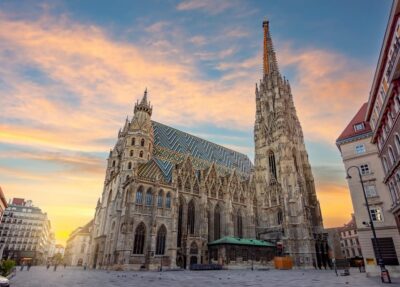
Guided Walking Tour of City Highlights & Hidden Gems
Read our review →
Vienna Historic Center Small Group Walking Tour
Read our review →
Ghosts and Legends Guided Nighttime Walking Tour
Read our review →Browse the lists this tour appears in