
Reviewed · WALKING TOURS
Private Klimt & Vienna Art Walk — From Baroque to Secession
Gustav Klimt’s The Kiss is the star here, but this private Vienna art walk gives you more than a quick museum stop. You trace the city’s change from Prince Eugene’s Baroque palace to the rebellious Art Nouveau of Klimt and Otto Wagner, with guides such as Walter or Wolfgang adding art, politics, and local history along the way.
I like the private format for up to eight people, since your guide can adjust the pace and answer real questions. I also like the route’s two Klimt anchors: The Kiss at the Belvedere and the Beethoven Frieze at the Secession. The main caution is cost: $372.47 covers the group, but museum admissions and public transport are extra, and four hours includes plenty of walking.
In This Review
- Key points at a glance
- Two Klimt masterpieces frame the morning or afternoon
- Entering the Belvedere gardens and palace
- Baroque power in the Lower Belvedere
- Schwarzenbergplatz and the city’s complicated memory
- Karlskirche and the Baroque city
- Otto Wagner’s Karlsplatz station and Vienna around 1900
- Musikverein and Vienna’s musical identity
- The Secession Building and Klimt’s Beethoven Frieze
- Naschmarkt for a practical finish
- Pace, walking, and private attention
- What the $372.47 group price really buys
- Who should book this art walk
- Final call: a strong choice for Klimt with city context
- FAQ
- How long is the Private Klimt and Vienna Art Walk?
- What time does the tour start?
- Is this a private tour?
- Where can pickup take place?
- Are museum admission tickets included?
- Is public transportation included?
- Will I see Klimt’s The Kiss?
- Will I see the Beethoven Frieze?
- Does the tour include food at Naschmarkt?
- Can I cancel for a full refund?
Key points at a glance
- Klimt’s two major Vienna works: See The Kiss at the Belvedere and the Beethoven Frieze at the Secession.
- A private group of up to eight: The guide can adapt explanations and walking speed to your party.
- Baroque to Art Nouveau in one route: Connect palace gardens, Karlskirche, Otto Wagner, Musikverein, and Klimt.
- Hotel and station pickup: Meet at a Vienna hotel, vacation rental, Reichsbrücke pier, Vienna Hbf, or Vienna West station.
- Morning or afternoon departures: Tours begin at 9:30 or 14:00.
- Bring your walking shoes and budget for extras: Admissions, public transport, food, and personal spending are not included.
Two Klimt masterpieces frame the morning or afternoon
The tour works because it connects two different Klimt experiences rather than treating the artist as an isolated museum subject. At the Upper Belvedere, you see The Kiss in the Austrian Gallery, Klimt’s most famous work and one of Vienna’s essential art stops.
At the Secession Building, you see the Beethoven Frieze, a work tied to music, symbolism, and the artistic rebellion of Vienna around 1900. The two paintings give you a useful comparison. One is an iconic, gold-covered painting in a grand palace museum. The other was created directly on the walls of an exhibition building designed as a statement against Vienna’s old art establishment.
That pairing makes the tour especially useful if you know Klimt mainly from postcards. You get the famous image, but you also see the building and artistic circle that explain why Klimt mattered in Vienna.
The tour is led by a licensed Austria Guide. Walter is the guide most often named in the supplied information, while Wolfgang also led at least one art-focused visit. Walter’s approach includes art history, Austrian politics, architecture, and personal interpretation. That can make the walk lively and distinctive, but you should be comfortable with a guide who may share opinions rather than stick to a strictly neutral script.
More walking tours in Vienna:
- Vienna: Guided Walking Tour of City Center Highlights
★ 4.7 · 4,989 reviews - Vienna: Vienna Central Cemetery Guided Walking Tour
★ 4.8 · 3,307 reviews - Vienna: Guided Walking Tour of City Highlights & Hidden Gems
★ 4.9 · 2,180 reviews
Entering the Belvedere gardens and palace
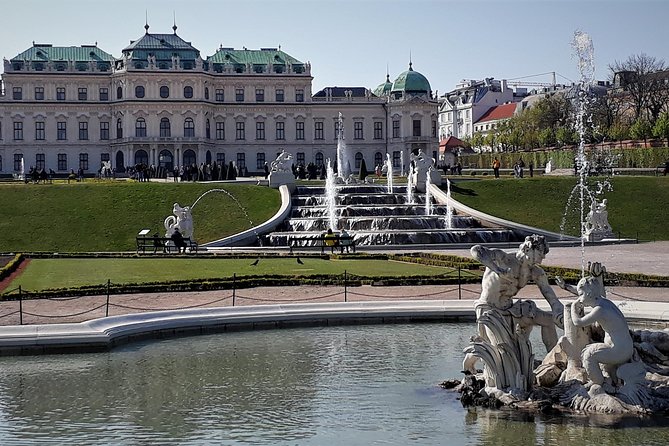
Your first major stop is the Belvedere Museum. The route begins at the wrought-iron gates, then moves through the formal gardens toward the palace. The garden is not merely a pretty approach. Its three levels were designed to create changing views and visual effects as you move downhill.
Your guide explains how the garden relates to the palace and how Prince Eugene of Savoy brought a Versailles-inspired style to Vienna. The scale is smaller than Versailles, but the message is similar: power displayed through symmetry, elevation, fountains, and carefully controlled sightlines.
You spend about 40 minutes at the Belvedere portion of the tour. Skip-the-line access is included as a tour feature, which matters because The Kiss is one of Vienna’s busiest art attractions. The admission ticket itself is not included, so you must account for that separate cost when comparing this tour with a standard museum visit.
The wording around skip-the-line access deserves attention. It means the tour is designed to help you avoid the regular line, but it does not mean the museum visit is free. Confirm the current admission arrangement when booking, especially since the tour is subject to availability and confirmation is sent within 48 hours.
Inside the Austrian Gallery, the focus turns to Klimt and The Kiss. The strongest part of the guiding, based on the tour format and feedback, is the connection between Klimt’s life, his artistic friends, and the Vienna of around 1900. You are not simply pointed toward the gold painting and left to take a photo.
The Belvedere itself is part of the lesson. Its palace setting helps you see how far Vienna had moved from courtly Baroque display by the time Klimt and his colleagues began challenging established art institutions.
Baroque power in the Lower Belvedere
As you leave the upper palace, the route continues through the gardens and toward the Lower Belvedere. The garden room and honor court help explain what Prince Eugene wanted his Vienna residence to communicate.
This section is valuable because it puts Klimt in a longer story. Vienna did not suddenly become an Art Nouveau city. It first developed through imperial ambition, court culture, church building, and a taste for grand visual statements.
The Lower Belvedere portion is also a reminder that the tour is not only about interiors. You spend time moving between gardens, courtyards, and city streets. If you prefer a museum tour with a chair and a slow gallery pace, this will feel active. If you want architecture and city context along with paintings, the route earns its time.
Schwarzenbergplatz and the city’s complicated memory
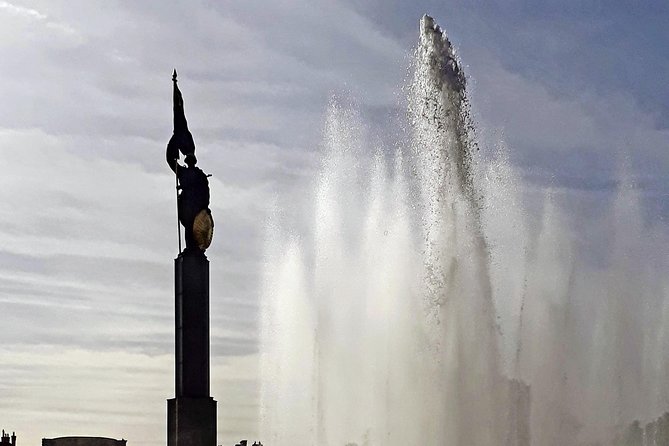
From the Belvedere area, the tour heads toward Schwarzenbergplatz. The square is dominated by the Soviet Memorial and surrounded by buildings linked to Vienna’s rapid growth in the late nineteenth century.
This is one of the more unusual parts of the route. The square lets your guide shift from art to twentieth-century politics and from imperial Vienna to the city’s postwar reality. The Soviet Memorial is a major visual marker, and its presence beside grand urban buildings creates a sharp contrast.
Walter’s guiding style includes personal views on subjects such as Austria’s relationship with NATO and Russia. That is not a small detail. The private-tour description allows guides to share personal opinions, and the supplied feedback shows that this approach has been both appreciated and strongly criticized.
I would treat this as a fit question. If you enjoy discussion and want more than a polished recital of dates, you may appreciate the freedom. If you prefer political subjects handled with strict restraint, tell the guide early that you want the focus kept on art and architecture.
A few more Vienna tours worth weighing up
- Vienna: Private Walking Tour with a Local Guide
★ 4.6 · 1,420 reviews - Vienna: Private Walking Tour with a Guide
★ 4.7 · 962 reviews - Vienna: Wine Tasting Experience in a Private Wine Cellar
★ 4.8 · 413 reviews - Private Day Tour Trip Salzburg Hallstatt and Melk from Vienna
★ 5.0 · 388 reviews
Karlskirche and the Baroque city
The next church stop presents Baroque Vienna at full volume. Built to impress from a distance, Karlskirche sets the tone for the city’s eighteenth-century glory.
You learn to read the building as part of its era rather than as a stand-alone church. The scale, decoration, and placement express the confidence of a powerful court and a city shaped by imperial ambition. This is a useful counterpoint to the Secession Building later in the walk. Karlskirche represents an official style backed by authority. The Secession represents artists breaking away from an established institution.
The tour does not list an interior admission for Karlskirche, so you should expect this to be an exterior and area explanation unless your guide confirms otherwise. The route covers many major sights in a few hours, but it is not a full museum program at every stop.
Otto Wagner’s Karlsplatz station and Vienna around 1900
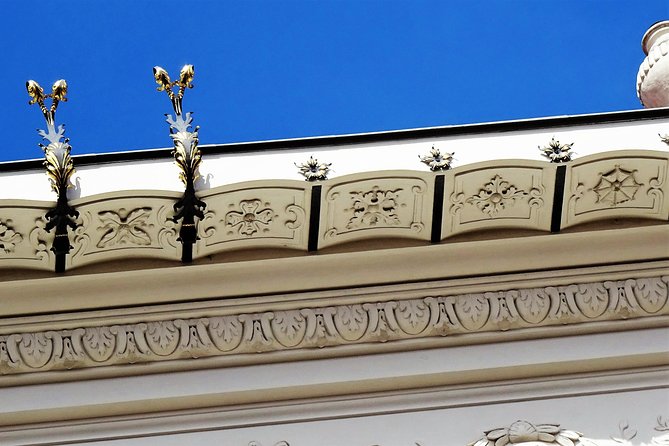
At Karlsplatz, the focus shifts from Baroque to Art Nouveau. Otto Wagner’s metro station is a practical building with an elegant design, and it shows how Vienna’s artistic ambitions reached everyday public infrastructure.
This is one of the best links in the itinerary. Klimt is easier to understand when you see that Art Nouveau was not limited to paintings. It shaped architecture, transport, furniture, graphic design, and the look of the modern city.
The station also gives you a sense of Vienna’s changing pace. Palace gardens and ceremonial churches belong to an older order. A metro station belongs to an expanding city that needed new systems and new visual language.
Several positive accounts of the tour praise the guide’s ability to explain art and history while using the Metro. Public transportation is not included, so carry a valid ticket or plan to buy one separately if the route uses it. The guide’s explanations may make the ride part of the tour, but the fare remains your responsibility.
Musikverein and Vienna’s musical identity
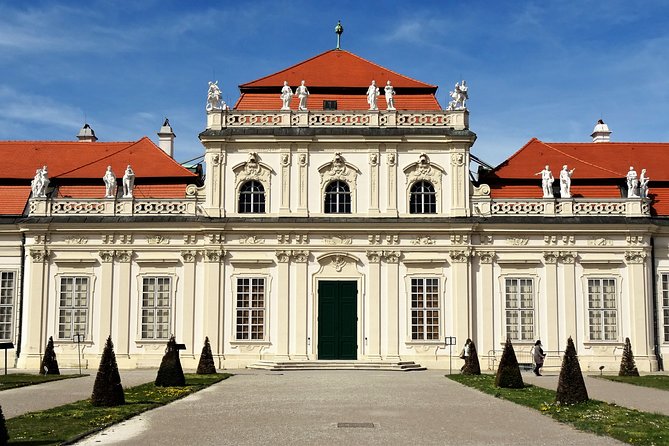
The Wiener Musikverein is the home of the Vienna Philharmonic and one of the world’s best-known concert halls. Its Golden Hall is celebrated for its acoustics and ornate design.
The tour treats the Musikverein as part of Vienna’s cultural network. That matters because the Secession’s Beethoven Frieze was made for an exhibition celebrating Beethoven. Music is not a side note here. It helps explain the artistic mood of Vienna around 1900 and the way painters, composers, architects, and writers influenced one another.
Do not assume that a concert is included. The itinerary describes the building and its importance, not a concert performance or interior concert-hall admission. The value is in seeing how the city’s musical identity connects with Klimt’s work.
The Secession Building and Klimt’s Beethoven Frieze
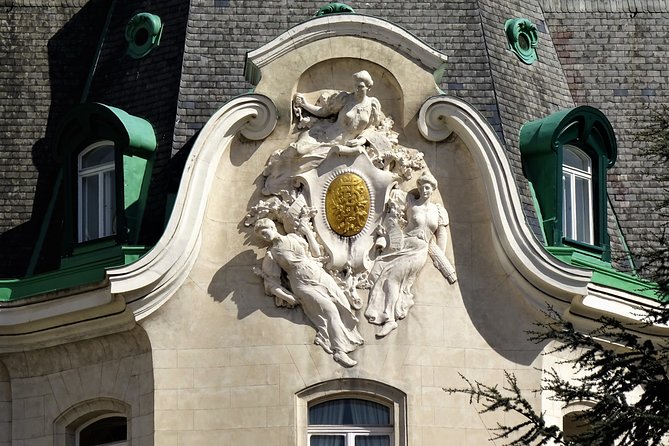
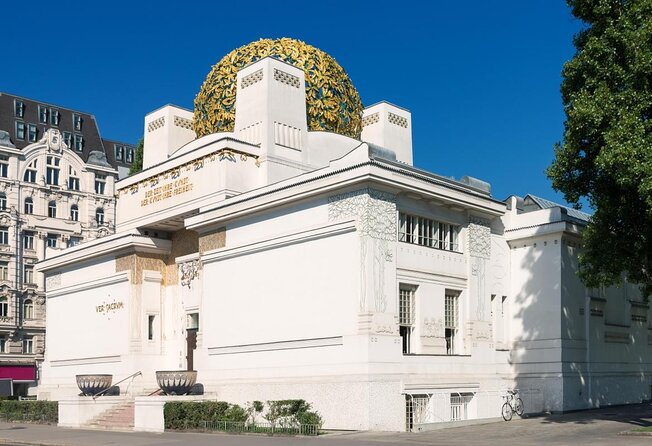
The Secession Building is the architectural centerpiece of the second half of the tour. Its dome of gilded leaves makes the building easy to spot, but the important point is its purpose. It was built by artists who broke from Vienna’s long-established fine-art institution.
That makes the building an architectural manifesto, not just another Art Nouveau façade. Your guide explains why the artists needed their own exhibition space and how the building announced a new direction.
Inside, Klimt’s Beethoven Frieze is the key work. It was created for an exhibition celebrating Beethoven and was intended as a temporary installation. Klimt painted it directly onto the walls using light materials, creating a work that belongs to the building as much as to the artist.
The frieze culminates in the idea of a kiss to the world, which gives the tour a satisfying link back to The Kiss at the Belvedere. You see two works connected by themes of love, symbolism, ornament, and the artistic culture of Vienna around 1900, but in very different settings.
The Secession visit lasts about 30 minutes. Admission is not included, just as at the Belvedere. If Klimt is your main reason for booking, these separate ticket costs are worth calculating before you commit. The tour’s skip-the-line feature may save time, but it does not remove the admission charge.
Naschmarkt for a practical finish
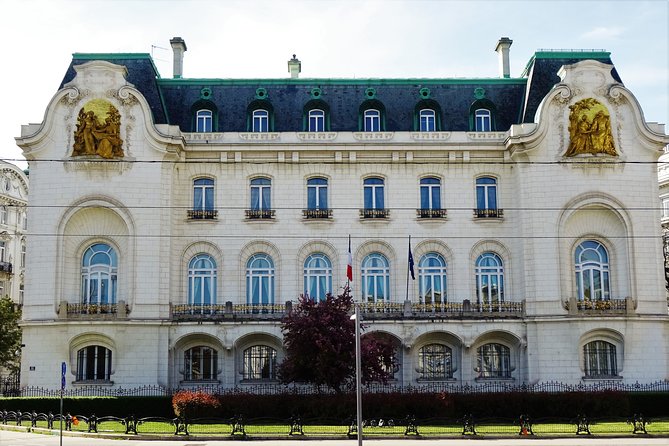
The route ends near the Naschmarkt, whose current form dates to 1915. It is part market, part international food stop, and a sensible place to finish a long art walk.
You can use the market for an outdoor lunch or a late-afternoon snack, but food is not included. This is a useful ending because the tour does not leave you at a remote palace with no clear next step. You finish in a part of central Vienna where you can eat, continue walking, or make your own way back.
The market is described as being in a transitional stage, so do not expect a perfectly preserved old-world food scene. Its appeal is the mix of market activity and international eating, along with its convenient position near the Secession and Karlsplatz area.
Pace, walking, and private attention
Four hours is a serious half-day. You cover the Belvedere, its gardens, central Vienna, Schwarzenbergplatz, Karlskirche, Karlsplatz, Musikverein, the Secession, and Naschmarkt. The route includes museum time, outdoor explanations, and likely public transport, so comfortable shoes are essential.
The physical requirement is listed as moderate. One account praises the guide for adjusting to a slower walker, while another found the pace slow and the guide’s energy limited. Those comments are not really contradictory. A private walk can be adjusted, but the route still requires you to go the distance.
If someone in your group has already taken a long morning walk, four hours may feel demanding. The tour is best for people who want to cover ground and hear sustained explanations, not for anyone seeking a relaxed café-to-café stroll.
The private format is a real advantage for families and small groups. Only your group participates, and the maximum is eight people. You can ask for more Klimt, more architecture, or more political background. You can also ask the guide to slow down when a painting or building deserves extra time.
What the $372.47 group price really buys
At $372.47 per group of up to eight, the price is not cheap for two people. For a full group, though, the cost works out to about $46.56 per person before admissions and transport. The key value is not simply the four hours. It is the private guide, pickup, route planning, and help with two busy art sites.
Pickup is offered at hotels and vacation rentals in Vienna, as well as the Reichsbrücke pier, Vienna Hbf, and Vienna West train stations. Other meeting points can be arranged. That saves planning time, especially if Vienna is one stop in a larger trip.
The price does not include Upper Belvedere admission, Secession admission, public transportation, or personal spending. A budget-minded couple may find a regular museum visit and self-guided walk less expensive. A family or group of friends can get better value from sharing the fixed fee.
The tour is often booked well ahead, with an average booking lead time of 64 days. That is useful planning information if your Vienna dates are fixed. Morning departures begin at 9:30, and afternoon departures begin at 14:00.
Who should book this art walk
I would choose this tour if you want Klimt explained within Vienna’s larger artistic and political setting. It suits first-time visitors who want to see several major places quickly, as well as repeat visitors who want a clearer link between Baroque Vienna and the Secession movement.
It is also a good choice for a private group with mixed interests. Someone who cares about Klimt gets the Belvedere and Secession. Someone more interested in architecture gets Baroque gardens, Karlskirche, Otto Wagner, and the Musikverein. Someone focused on history gets the imperial period, Vienna’s growth, and the Soviet Memorial.
I would hesitate if your main goal is maximum museum time. The Belvedere and Secession visits are focused, not exhaustive. I would also hesitate if you dislike guides who add personal political opinions or older-style humor. Walter’s comments suggest that his approach can be direct and opinionated, while one account also found some jokes dated.
The overall rating is 4.6 from 16 reviews, with many strong marks for art explanations, the Belvedere, pacing, and the guide’s ability to make the city easier to understand. That is a solid record, but the small number of ratings means you should read the guide style carefully rather than rely on the number alone.
Final call: a strong choice for Klimt with city context
Book this tour if you want The Kiss and the Beethoven Frieze tied to the city that produced them. The route gives you a useful progression: Baroque palace power, nineteenth-century urban growth, Art Nouveau design, Vienna’s musical culture, and Klimt’s artistic rebellion.
For the best value, bring a full group and reserve early. Set aside money for both museum admissions and public transport, wear shoes suited to several hours on foot, and tell the guide what interests you most. Choose Walter or Wolfgang if available, while keeping in mind that the guiding can include personal views.
Skip it if you want a low-cost museum visit, a short walk, or a strictly neutral lecture. For everyone else, this is a well-built half-day introduction to Klimt and the Vienna of around 1900, with enough Baroque grandeur to show where that modern movement came from.
FAQ
How long is the Private Klimt and Vienna Art Walk?
The tour lasts approximately four hours.
What time does the tour start?
You can choose a 9:30 start or a 14:00 start.
Is this a private tour?
Yes. Only your group participates, with a maximum of eight people.
Where can pickup take place?
Pickup is offered at Vienna hotels and vacation rentals, the Reichsbrücke pier, Vienna Hbf, and Vienna West train station. Other meeting points can be arranged.
Are museum admission tickets included?
No. Admission to the Upper Belvedere and the Secession Building is not included.
Is public transportation included?
No. Public transportation costs are separate. The tour may include explanations while riding the Metro, according to the tour information.
Will I see Klimt’s The Kiss?
Yes. The route visits the Austrian Gallery in the Upper Belvedere, where you can see The Kiss. The museum admission is not included.
Will I see the Beethoven Frieze?
Yes. The itinerary includes the Secession Building, where Klimt’s Beethoven Frieze is displayed. Admission is not included.
Does the tour include food at Naschmarkt?
No. The Naschmarkt is a suggested place for lunch or a snack, but personal expenses are not included.
Can I cancel for a full refund?
Yes, if you cancel at least 24 hours before the experience start time. Cancellations made less than 24 hours in advance are not refunded, and late changes are not accepted.
Just added around Vienna
- Private Tour from Vienna to Melk and Dürnstein★ 4.5 · 3 reviews
- Vienna: Johann Strauss 200th birthday anniversary exhibition★ 4.7 · 3 reviews
- Vienna Private Full Day Tour – Tickets to Schönbrunn & Lunch★ 5.0 · 3 reviews
- Private Salzburg Day Trip from Vienna★ 4.0 · 3 reviews
- Vienna: Entry Ticket Belvedere 21 & Contemporary Art★ 4.3 · 3 reviews
- Full-Day Private Trip from Vienna to Budapest★ 4.5 · 3 reviews
- Vienna by Night: Private Evening Food and Drink Tour★ 5.0 · 3 reviews
- 1.5 Hour Cinematic Style Portrait Photoshoot and Tour in Vienna★ 4.5 · 3 reviews
Walking Tours, compared.
Guided Walking Tour of City Center Highlights
Read our review →
Guided Walking Tour of City Highlights & Hidden Gems
Read our review →
Vienna Historic Center Small Group Walking Tour
Read our review →
Ghosts and Legends Guided Nighttime Walking Tour
Read our review →Browse the lists this tour appears in