
Reviewed · WALKING TOURS
Private Vienna Art Nouveau Walking Tour
Vienna’s Art Nouveau is easiest to understand when you see it as a citywide argument about modern design. This private walk connects Klimt’s Beethoven Frieze with Otto Wagner’s elegant metro stations, apartment buildings, and Postal Savings Bank, giving you the story behind details you could easily miss on your own. I like the direct route from the Secession Building to Karlsplatz, and I like that a private guide can adjust the talk for serious architecture fans or complete newcomers.
The guides, including Barbara, Wolfgang, and Annelie, bring different personalities to the experience, but the common thread is careful explanation and plenty of room for questions. The main drawback is cost: $490 per group, even with up to 10 people, is a major spend for a three-hour walk, and entrance fees are extra.
In This Review
- Key points to know before booking
- Why Vienna’s Art Nouveau makes a strong walking theme
- The Secession Building and Klimt’s dramatic Beethoven Frieze
- Stadtpark: a quieter pause between major buildings
- Karlsplatz and the graceful Otto Wagner pavilions
- Postsparkasse shows Wagner at his most practical
- Naschmarkt adds everyday Vienna to the architecture
- What the private format is really worth
- Guides, questions, and the human side of the walk
- Timing, meeting point, and extra costs
- Who should book this Vienna walk?
- FAQ
- How long is the Private Vienna Art Nouveau Walking Tour?
- Is this a private tour?
- What is included in the tour price?
- Is hotel pickup included?
- Are entrance fees included?
- Does the tour include food or drinks?
- Where does the tour begin?
- What is the cancellation policy?
- Should you book it?
Key points to know before booking
- Klimt’s Beethoven Frieze gives the tour an exceptional interior highlight, though admission to the Secession Building costs extra.
- Otto Wagner’s Karlsplatz pavilions and metro designs show how practical transport architecture became fine art.
- The private format suits mixed-interest groups, since your guide can spend more time on art, buildings, or Vienna’s wider story.
- The route includes both major sights and easy-to-miss details, including Postsparkasse, Stadtpark, and Naschmarkt.
- Allow extra money for admissions, especially the Secession Building and the Otto Wagner Pavilion when it is open.
- The three-hour length is focused rather than exhausting, but the experience is still a walking tour through central Vienna.
Why Vienna’s Art Nouveau makes a strong walking theme
Vienna’s version of Art Nouveau is usually called Jugendstil or Vienna Secession. It was not simply a taste for curved lines and decorative façades. Around the turn of the 20th century, artists and architects wanted to break from older academic rules and create work suited to modern city life.
That tension gives this tour its shape. You begin with artists who wanted a new kind of exhibition building, then see how Otto Wagner applied modern design to public transport, apartments, and banking. The result is more interesting than a parade of pretty façades. You get a sense of how Vienna tried to present itself as a modern capital while still carrying the weight of the imperial past.
I particularly like this subject for a private tour because Art Nouveau rewards close looking. A guide can point out a material, motif, or structural choice, then connect it to the next stop. Without that help, you may see a decorated station and move on. With the right explanation, the station becomes part of a much larger change in Vienna’s architecture.
The tour is also a good match for mixed groups. Someone who already knows Klimt can focus on design and urban planning, while someone new to the period can get the basic story without feeling lost. The private setting means your questions do not have to wait for a group of strangers.
More walking tours in Vienna:
- Vienna: Guided Walking Tour of City Center Highlights
★ 4.7 · 4,989 reviews - Vienna: Vienna Central Cemetery Guided Walking Tour
★ 4.8 · 3,307 reviews - Vienna: Guided Walking Tour of City Highlights & Hidden Gems
★ 4.9 · 2,180 reviews
The Secession Building and Klimt’s dramatic Beethoven Frieze
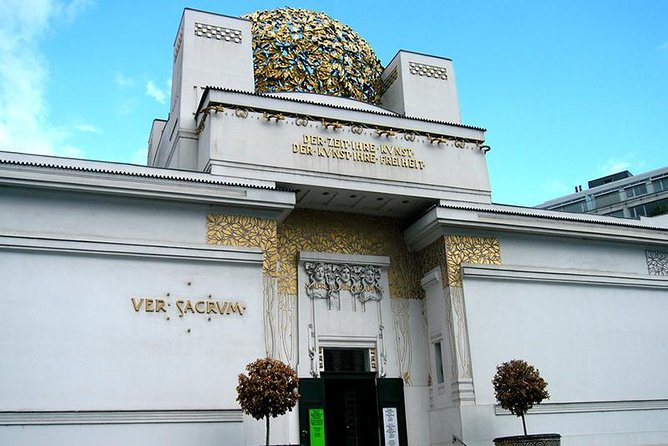
The Secession Building is the natural artistic opening. Joseph Maria Olbrich completed it in 1898 as an exhibition hall and architectural statement for the Vienna Secession, a group of artists who broke away from Vienna’s established fine art institution.
Its exterior is famous for its unusual dome of gilded foliage, often called the cabbage-head dome. Even if you know the building from photographs, seeing it in context helps. It was designed to announce a new artistic movement, not to blend quietly into the older city around it.
Inside, the main attraction is Gustav Klimt’s Beethoven Frieze. The monumental work was painted for one of the original Secession exhibitions and presents a symbolic journey involving human desire, struggle, and artistic redemption. It is not a quick glance at a framed painting. The scale and setting matter.
You get about 30 minutes here, and admission is not included. From Tuesday through Sunday, the stated admission is €9.50 for adults and €6 for students and seniors. The tour guide helps with payment, which is useful, but you should still plan for the added cost.
The Secession visit is especially valuable if you appreciate Klimt but know little about the Vienna Secession itself. The building and the artwork explain each other. The exterior tells you that the artists wanted a new platform, while the frieze shows how ambitious their ideas could be.
One limitation is timing. Thirty minutes is enough for an introduction and a focused look, but not a long independent visit. If the frieze is your main reason for booking, tell your guide early so you can use the stop well.
Stadtpark: a quieter pause between major buildings
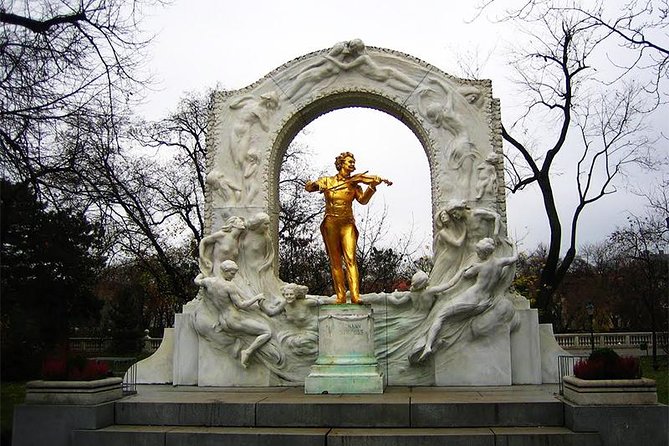
Stadtpark gives the route a change of pace. The municipal park stretches from the Ringstraße in Vienna’s first district toward Heumarkt, creating a useful outdoor break between architectural stops.
You spend about 15 minutes here, with no admission fee. This is not the tour’s main Art Nouveau monument, and you should not expect a long park visit. Its value is practical and visual. After the concentrated detail of the Secession Building, the open space lets you reset before returning to Otto Wagner’s work.
A private guide may also use the park to explain Vienna’s broader urban setting or answer questions from the first part of the walk. If you are mainly interested in buildings, the stop may feel brief. If you enjoy seeing how monuments and public spaces fit together, it helps give the route breathing room.
Karlsplatz and the graceful Otto Wagner pavilions
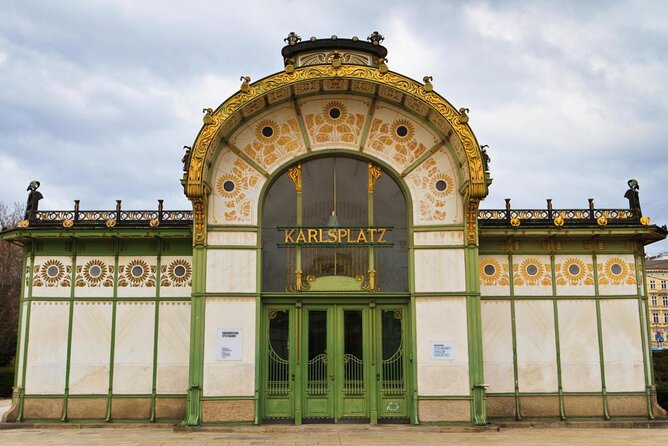
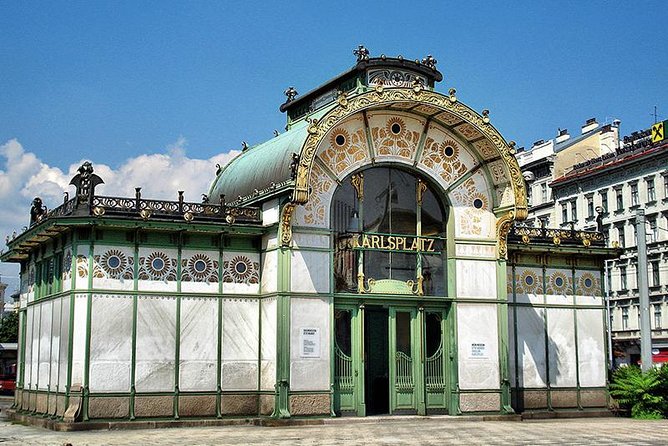
Karlsplatz is one of the tour’s strongest architectural sections. The former Karlsplatz Stadtbahn station buildings were designed by Otto Wagner, with Joseph Maria Olbrich also involved in the work. They were part of Vienna’s Stadtbahn system, but their decorative metalwork, marble, and carefully controlled proportions give them the presence of small monuments.
This is where Wagner’s ideas become easy to grasp. He was designing for a modern transport network, yet he refused to treat stations as disposable utility buildings. The result is a practical structure with an unusually polished public face.
The two pavilions are among the most photographed Art Nouveau features in Vienna. Their location also makes them easy to appreciate from outside, since the forms are compact and readable. You do not need an entire morning to understand their basic design logic, but a good guide can show you how the details relate to Wagner’s larger work.
The formal Karlsplatz stop takes about 20 minutes, followed by around 15 minutes at the Otto Wagner Pavilion. The pavilion houses an exhibition about Wagner’s life and work in one of the 1898 station buildings he designed. Admission is not included.
From April through October, when the museum is open, the listed admission is €5 for general admission and €4 for seniors, students, Vienna Card holders, and people with disabilities. That small fee can add useful context, especially if you want more than an exterior photograph.
The seasonal opening matters. If your visit falls outside the museum season, you may see the pavilion from outside but not receive the interior exhibition. Ask about the current opening arrangements when booking if this stop is important to you.
A few more Vienna tours worth weighing up
- Vienna: Private Walking Tour with a Local Guide
★ 4.6 · 1,420 reviews - Vienna: Private Walking Tour with a Guide
★ 4.7 · 962 reviews - Vienna: Wine Tasting Experience in a Private Wine Cellar
★ 4.8 · 413 reviews - Private Day Tour Trip Salzburg Hallstatt and Melk from Vienna
★ 5.0 · 388 reviews
Postsparkasse shows Wagner at his most practical
The Austrian Postal Savings Bank, or Postsparkasse, is one of Otto Wagner’s best-known Vienna buildings. It is associated with the Vienna Secession and shows how the movement could work on a large civic commission.
The stop lasts about 25 minutes and is free. That makes it one of the tour’s best value moments. You see an important building without paying another entrance fee, while your guide explains how Wagner handled a bank rather than a station or private home.
Postsparkasse is worth examining for its disciplined surface and functional purpose. Wagner did not decorate the building in the same way an older palace might be decorated. Its modern character comes from the relationship between structure, materials, pattern, and use.
This is also a good place to ask about the difference between Art Nouveau as a broad European movement and Vienna Secession design as a local response. The terms overlap, but they are not interchangeable in every discussion. A private guide can adjust the explanation to your level instead of giving a fixed lecture.
Naschmarkt adds everyday Vienna to the architecture
Naschmarkt is a short stop of about 10 minutes. Vienna’s best-known culinary market has around 120 colorful market stalls and restaurants, making it a useful contrast to the formal buildings earlier in the walk.
Food and drinks are not included, so this is not a meal stop. Think of it as a chance to see one of central Vienna’s everyday public spaces and to connect the route with the city people use for shopping and eating.
The short timing means you will not have much room to browse. If you want to return for lunch or a longer look, plan that separately. The market works well at the end because it leaves you near places where you can continue exploring on your own.
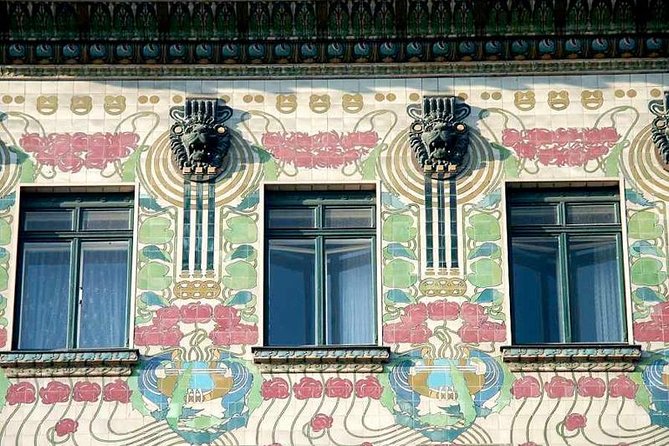
Some versions of the art-focused route also draw attention to nearby Jugendstil buildings such as the Majolikahaus and the Zacherl House. These are important names to raise with your guide, since they help broaden the picture beyond the formal stops listed for the three-hour walk. Do not assume every interior visit is included, but asking about nearby façades can make the final section more rewarding.
What the private format is really worth
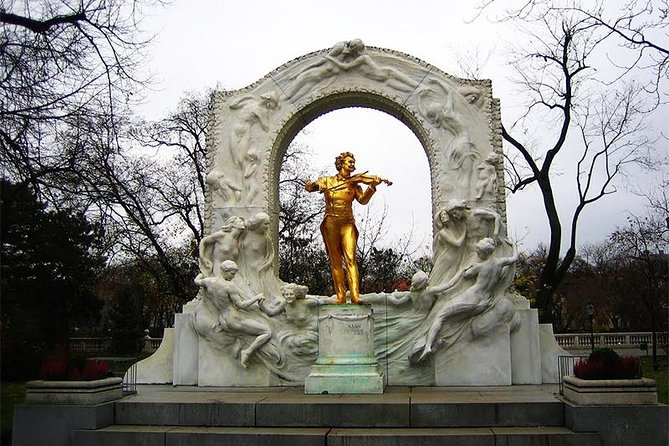
The tour costs $490 per group of up to 10 people. For one or two people, that is expensive. For a full group, the per-person price becomes far more reasonable, especially when compared with booking several separate private activities.
The value depends on what you want from the walk. If you only need directions to Karlsplatz and the Secession Building, you can see the exteriors independently for much less. If you want the connections between Klimt, Olbrich, Wagner, public transport, and Vienna’s modern art movement, the guide is the main product.
I would consider the price strongest for a small group of friends or family members with a real interest in art and buildings. It can also work well for a group with different knowledge levels, since a private guide can stop when someone has a question or move faster when the subject is familiar.
The tour is booked, on average, about 11 days ahead. That does not guarantee that every date will sell out, but it is a useful planning signal. If you have a fixed Vienna schedule, booking ahead is sensible.
The experience lasts about three hours. That is long enough to create a coherent story without turning the day into an architecture marathon. You should still wear comfortable shoes and expect a walking-focused outing, even though the route includes public transport architecture.
Guides, questions, and the human side of the walk
The strongest part of a private architecture tour is often the guide’s ability to make specialist material accessible. Barbara is described as thorough and pleasant, with a knack for answering questions about Vienna’s past and present. Wolfgang guided a December 2024 visit and helped make the movement understandable to someone who had not studied it before. Annelie is associated with clear explanations of Vienna Secession and Vienna itself.
Those names do not guarantee which person you will receive. They do show the kind of guiding style you can expect: historical context, attention to architecture, and room for questions rather than a silent march between photo stops.
I would tell the guide what interests you at the start. Mention Klimt if you want more time on the Beethoven Frieze. Mention Wagner if transport design and urban planning matter most. If you are less familiar with Art Nouveau, say so. The tour is most useful when the explanation meets you at your level.
Timing, meeting point, and extra costs
The listed start point is Operngasse 7, 1010 Wien, near public transportation. The tour ends in Vienna, with the precise final location depending on the route and guide. Confirm the meeting details before setting out, particularly if you are relying on a tight connection afterward.
Pickup is offered in the general tour information, but hotel pickup and drop-off are listed as not included. Treat the meeting point as the practical plan unless your booking confirmation says otherwise.
Budget for the Secession Building admission and, from April through October when open, the Otto Wagner Pavilion admission. Food and drinks are also your responsibility. There is no need to budget for Stadtpark, Postsparkasse, or Naschmarkt admission.
Most people can participate, and the activity is near public transportation. The private format means only your group takes part, which is useful if you want to keep the pace comfortable or ask detailed questions without holding up strangers.
Free cancellation is available when you cancel at least 24 hours before the local start time. Changes or cancellations inside that window are not accepted for a refund.
Who should book this Vienna walk?
I would book it if you enjoy architecture, design, urban planning, or the story of modern Vienna. It is also a strong choice if you like Klimt but want to place his work within the wider Secession movement rather than treating him as an isolated painter.
The tour suits first-time art visitors because the guide provides a clear framework. It also suits serious enthusiasts who want to ask about materials, function, and the difference between decorative design and structural innovation.
I would be more cautious if you want a general city tour. Most of the three hours are aimed at Art Nouveau and related buildings, not Vienna’s imperial palaces, major museums, or broad political history. I would also think twice if the price is being paid by only one person and you are comfortable exploring exteriors independently.
FAQ
How long is the Private Vienna Art Nouveau Walking Tour?
The tour lasts approximately three hours.
Is this a private tour?
Yes. Only your group participates, with a maximum group size of 10 people.
What is included in the tour price?
The price includes a three-hour guided tour of Vienna Art Nouveau metro stations and notable buildings, along with a professional guide.
Is hotel pickup included?
Hotel pickup and drop-off are listed as not included. The stated starting point is Operngasse 7, 1010 Wien, Austria. Pickup is also offered in the general experience details, so confirm the exact arrangement at booking.
Are entrance fees included?
No. Admission fees are not included. The Secession Building costs €9.50 for adults and €6 for students and seniors from Tuesday through Sunday. The Otto Wagner Pavilion costs €5 for general admission and €4 for seniors, students, Vienna Card holders, and people with disabilities when open from April through October.
Does the tour include food or drinks?
No. Food and drinks are not included unless specifically stated. Naschmarkt is visited briefly, but the tour does not include a meal.
Where does the tour begin?
The listed meeting point is Operngasse 7, 1010 Wien, Austria.
What is the cancellation policy?
You can cancel for a full refund up to 24 hours before the experience start time. Cancellations or changes made less than 24 hours before the start are not accepted for a refund.
Should you book it?
Book this tour if you want Vienna’s Art Nouveau explained as a connected movement, not just a collection of attractive buildings. The Secession Building and Beethoven Frieze provide the artistic core, while Karlsplatz and Postsparkasse show how the same era shaped transport and civic life.
The price is easiest to justify when shared among a group, or when you care enough about architecture to want a specialist guide. If that sounds like you, the private format, strong guide choices, and focused three-hour route make this a useful addition to a Vienna visit.
Just added around Vienna
- Vienna: Johann Strauss 200th birthday anniversary exhibition★ 4.7 · 3 reviews
- Vienna Private Full Day Tour – Tickets to Schönbrunn & Lunch★ 5.0 · 3 reviews
- Private Tour from Vienna to Melk and Dürnstein★ 4.5 · 3 reviews
- Private Salzburg Day Trip from Vienna★ 4.0 · 3 reviews
- Vienna: Entry Ticket Belvedere 21 & Contemporary Art★ 4.3 · 3 reviews
- Full-Day Private Trip from Vienna to Budapest★ 4.5 · 3 reviews
- Vienna by Night: Private Evening Food and Drink Tour★ 5.0 · 3 reviews
- 1.5 Hour Cinematic Style Portrait Photoshoot and Tour in Vienna★ 4.5 · 3 reviews
Walking Tours, compared.
Guided Walking Tour of City Center Highlights
Read our review →
Guided Walking Tour of City Highlights & Hidden Gems
Read our review →
Vienna Historic Center Small Group Walking Tour
Read our review →
Ghosts and Legends Guided Nighttime Walking Tour
Read our review →Browse the lists this tour appears in