
Reviewed · WALKING TOURS
Walking Tours for Time Travelers
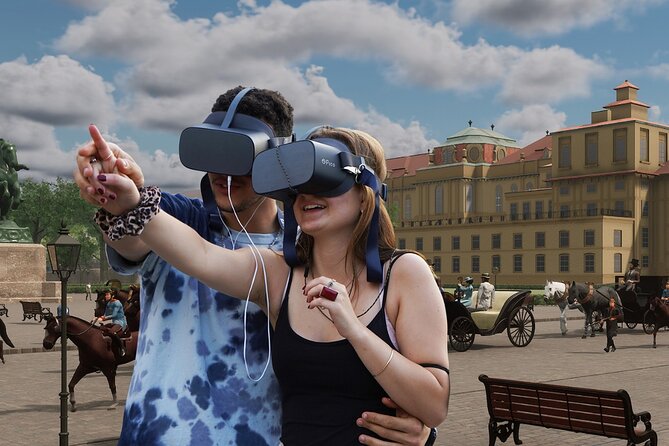
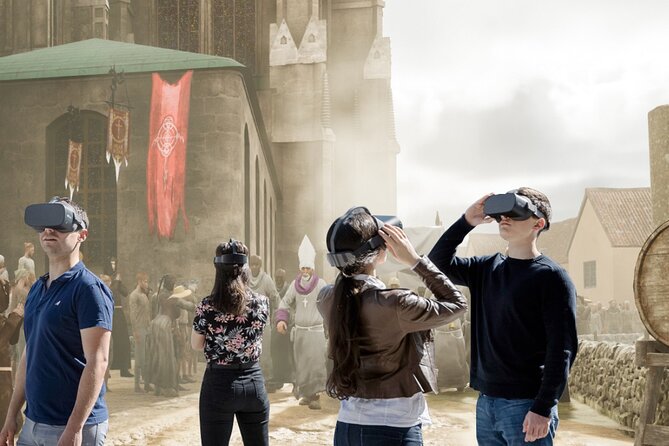
Vienna’s past gets a clever upgrade on this two-hour walk. At key Old Town sights, you put on VR glasses and see 360-degree 3D scenes showing how the city changed over time, then continue through the streets with an English audio guide explaining what you are seeing. The technology adds a visual link to the past, instead of leaving you to imagine vanished buildings and earlier city life from a modern street.
I like two things right away: the small limit of seven people, which should make it easier to hear the audio and handle the equipment, and the manageable route of about 2 to 3 kilometers. The main consideration is that this is not a traditional guide-led history walk. The commentary comes through an audio guide, and the VR portion may not suit anyone with epilepsy or children under 10.
In This Review
- Key points to know before booking
- Seeing Vienna’s past at street level
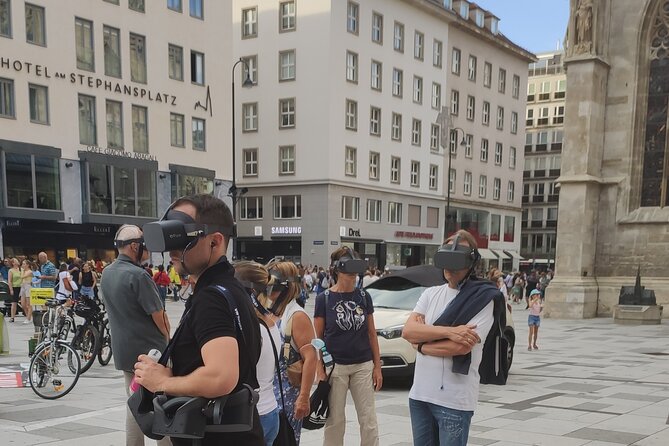
- St. Stephen’s Cathedral begins the time shift
- Graben connects history with modern Vienna
- The Hofburg puts imperial Vienna in context
- The Opera shows another side of the city
- Stephansplatz provides a natural finish
- What the audio guide adds
- How the VR scenes fit into the walk
- Is $47.17 a fair price?
- Group size, timing, and practical comfort
- Who will get the most from this experience?
- Should you book the Vienna VR walking tour?
- FAQ
- Where does the tour begin?
- Where does the tour finish?
- How long does the walking tour last?
- How far do you walk?
- Which landmarks are included?
- Is the tour offered in English?
- Is the tour suitable for everyone?
Key points to know before booking
- Five central Vienna stops: St. Stephen’s Cathedral, Graben, the Hofburg, the Opera, and Stephansplatz.
- VR at landmark locations: Use glasses to view historical scenes in 360-degree 3D animation.
- English audio guidance: The commentary explains Vienna’s changing appearance as you walk.
- Short, easy-to-manage route: Expect about two hours and roughly 2 to 3 kilometers on foot.
- Very small group: The tour accepts a maximum of seven people.
- Weather matters: Poor weather can lead to a new date or a full refund.
Seeing Vienna’s past at street level
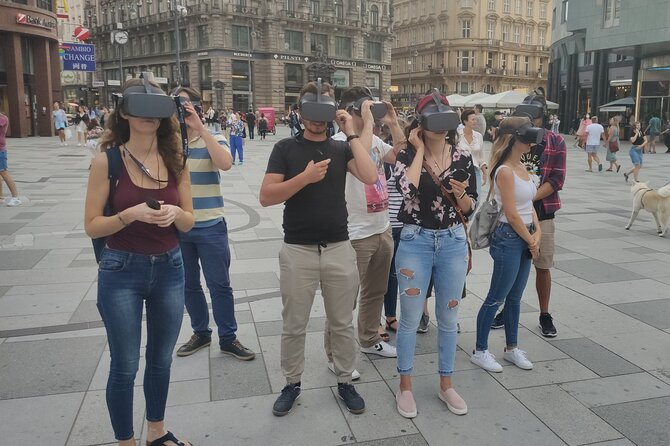
I like the basic idea because Vienna’s center can feel almost too polished. Grand façades, palace wings, churches, and broad pedestrian streets are easy to admire, but it is not always easy to picture what occupied the same space centuries ago. The VR scenes give you a visual comparison between the city in front of you and earlier versions of that place.
This is best understood as a moving history lesson rather than a sightseeing stroll with occasional facts. You walk from one important point to the next, listen to the audio explanation, and pause for a historical scene. That rhythm gives you time to notice the real buildings before and after the digital reconstruction.
The tour starts at Johannesgasse 21 in Vienna’s central 1010 district. From there, the route leads toward the main sights of the Old Town and finishes at Stephansplatz. Because the start and finish are in the city center, this can fit neatly into a day of sightseeing, though the provided details do not specify how close the office is to any particular transit stop.
More walking tours in Vienna:
- Vienna: Guided Walking Tour of City Center Highlights
★ 4.7 · 4,989 reviews - Vienna: Vienna Central Cemetery Guided Walking Tour
★ 4.8 · 3,307 reviews - Vienna: Guided Walking Tour of City Highlights & Hidden Gems
★ 4.9 · 2,180 reviews
St. Stephen’s Cathedral begins the time shift
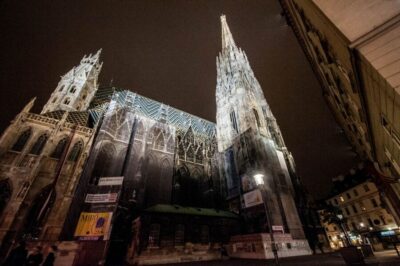
St. Stephen’s Cathedral is one of Vienna’s essential orientation points, and it makes sense as an early VR stop. Its scale and central location help you understand the Old Town before the route moves through the surrounding streets. The experience uses the cathedral as more than a photo stop: you pause there for a 360-degree scene showing an earlier stage of the city.
You will still be looking at the actual cathedral and its present-day surroundings. The value comes from switching between the real view and the animated historical view. That contrast can make Vienna’s long changes easier to grasp than a spoken description alone.
The audio guide continues to explain the site as you walk. If you are new to VR, the format should remain approachable because the technology is used at selected points rather than for the entire two hours. A practical benefit is that you do not need to spend the whole route looking through a headset.
Graben connects history with modern Vienna
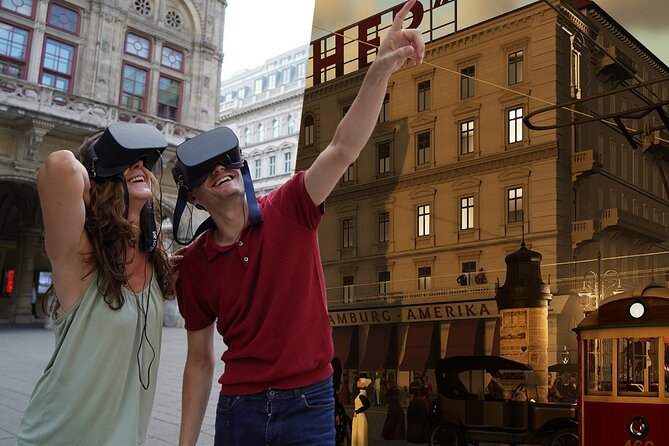
From the cathedral area, the tour reaches Graben, one of the most recognizable central streets in Vienna. This is a useful place for a time-travel format because you are walking through a public space that feels thoroughly modern while surrounded by old architecture and major city landmarks.
The stop helps show how Vienna’s center evolved as a place for movement, commerce, and public life. The audio commentary gives you the broad story while the VR scene supplies a more direct visual sense of earlier surroundings. I find that combination particularly helpful when a city’s present streets no longer reveal their former use clearly.
Do not expect an extended stop at every building along Graben. The tour has a fixed route and five named VR locations within about two hours. The emphasis is on the selected historical scenes, not on entering every monument or covering every side street.
The Hofburg puts imperial Vienna in context
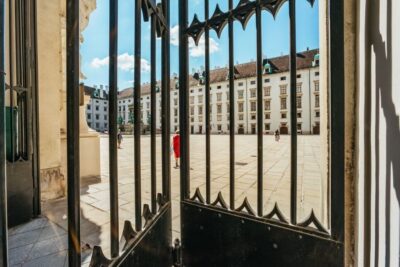
The Hofburg is the route’s grandest setting. This sprawling palace complex once served as the center of Habsburg power, and its many wings can be difficult to understand from the street. A historical VR scene here can help you picture the palace as a changing seat of authority rather than simply a collection of impressive façades.
The audio guide is important at this stop because the Hofburg can be visually overwhelming. You need some explanation to connect the buildings with the different stages of Vienna’s development. The tour’s format lets you take in the present-day palace while hearing how the city changed around it.
This is also where expectations matter. The experience does not include a listed palace interior visit, museum admission, or a separate guided tour inside the Hofburg. You should book it for the outdoor route and the VR storytelling, not as a substitute for visiting the Imperial Apartments or another Hofburg museum.
A different side of Vienna on the same trip:
- Vienna: Vivaldi’s Four Seasons Concert in Karlskirche
★ 4.7 · 14,951 reviews - Vienna: Spanish Riding School Training
★ 3.9 · 9,281 reviews - Vienna: Skip-the-cashier-desk-line Giant Ferris Wheel Ride
★ 4.5 · 7,859 reviews - Vienna: Schönbrunn Palace & Gardens Skip-the-Line Tour
★ 4.7 · 7,739 reviews
The Opera shows another side of the city
The Vienna Opera stop adds a different note to the route. While the cathedral and Hofburg point toward religious and political power, the Opera represents the city’s cultural identity. Seeing it within a walking tour of the Old Town creates a useful range of themes instead of keeping the focus on palaces alone.
The supplied details do not specify the exact historical scene shown at the Opera, so I would treat this stop as part of the broader time sequence rather than expect a particular performance or interior access. The important point is that the VR scenes occur at major places where the present-day city can be compared with its earlier form.
The Opera also helps break up the route. After several heavy architectural sights, a cultural landmark gives the walk a different focus. You continue to move through central Vienna rather than stopping for a long lecture in one place.
Stephansplatz provides a natural finish
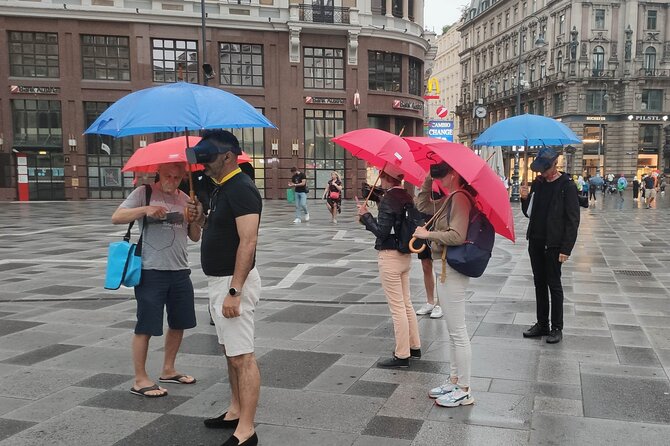
The tour ends at Stephansplatz, the open square around St. Stephen’s Cathedral. Finishing here makes practical sense because you are left in one of Vienna’s central pedestrian areas, with the cathedral and surrounding streets close at hand.
Stephansplatz is also a useful place to pause and think about the tour’s main idea. You have seen one city at several points in time, then return to the real square where modern Vienna carries on around you. The final location gives you a good base for continuing your own sightseeing, though no further activities are included in the tour details.
Because the start is at Johannesgasse 21 and the finish is at Stephansplatz, this is not a loop back to the office. Check the route before booking if you need to return to your starting point immediately. The two locations are both in the central 1010 district, but the tour does not provide a return transfer.
What the audio guide adds
The English audio guide is central to the experience. It talks you through the different stages of Vienna’s evolution while you walk, so you are not relying on the VR scenes alone. One useful detail is that the tour can still work for someone who has never used VR before, since the historical explanation remains part of the route.
I would choose this format if you like learning while moving. The audio lets you keep looking at the real streets instead of reading a page of information at every stop. It also gives the walk a steady structure, with narration between the five visual locations.
The tradeoff is personal. If you want lively back-and-forth conversation with a local guide, this may feel less personal than a conventional small-group walk. The group is limited to seven, but the information is delivered through audio rather than identified as live commentary from a named guide.
How the VR scenes fit into the walk
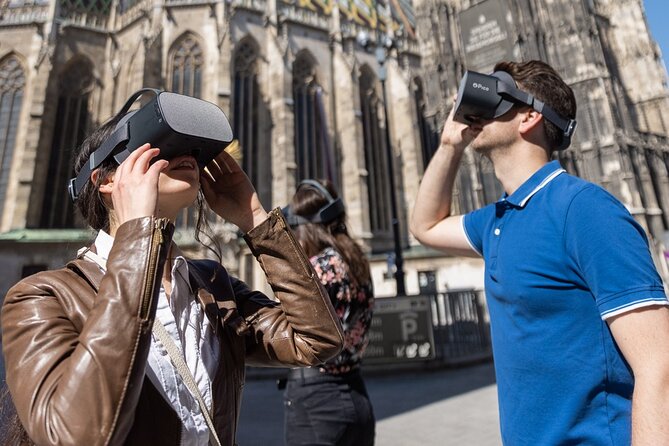
The VR is used at striking locations, not continuously. At each listed point, you stop and view a 360-degree 3D animation through the glasses. This makes the technology a tool for historical comparison, not a replacement for seeing Vienna itself.
That distinction matters. A headset can show you a version of the past, but you still need the real street, cathedral, square, and palace in front of you to understand the setting. The strongest part of this format is the quick change between present and past.
If you have never used VR, allow yourself a little patience at the first stop. The experience is designed for general participation, and the information says most people can take part, but the tour is specifically not suitable for people with epilepsy. It is also not suitable for children below age 10.
Is $47.17 a fair price?
At $47.17 per person, this costs more than a basic self-guided audio walk, but you are paying for more than spoken commentary. The price includes a structured two-hour route, the VR equipment and scenes, and a very small group capped at seven people.
The value is strongest if you are curious about the technology or find it hard to imagine historical change from architecture alone. The VR gives you something you cannot get from a standard walk, while the audio keeps the experience grounded in the actual city. The route also covers several major sights without requiring a full day.
The value is weaker if you already prefer free city walks, dislike wearing headsets, or want extensive detail on every landmark. Five VR stops in two hours means the experience has to keep moving. You will get a focused introduction to Vienna’s central history, not an exhaustive tour of the Old Town.
The short distance helps justify the price for many people. The route covers about 2 to 3 kilometers, so you can see several major sites without committing to a strenuous all-day walk. It is a compact option for an arrival day, a first morning in Vienna, or anyone who wants an introduction before choosing which palaces and museums to visit in depth.
Group size, timing, and practical comfort
The maximum of seven people is one of the better details here. Small numbers matter when equipment must be passed around, when everyone needs to hear instructions, and when the group stops in busy central spaces. A small group can also make the experience feel less like a scheduled crowd moving through the Old Town.
The tour lasts approximately two hours. One detailed account of the route described about 2 to 3 kilometers of walking during that time, which suggests a moderate pace rather than a long-distance hike. You should still expect to remain on your feet for most of the experience.
The tour operates in English, with the audio guide providing the commentary. It is near public transportation, and service animals are allowed. Most people can participate, but the epilepsy restriction and age limit are firm considerations.
Weather can affect the plan because the experience requires good weather. If poor conditions cancel the tour, you are offered another date or a full refund. For your own planning, avoid placing this activity before a fixed museum reservation or train departure unless you have enough spare time.
You receive confirmation at booking. Cancellation is free up to 24 hours before the start time for a full refund. Changes or cancellations made less than 24 hours before the start time are not accepted, and the local time in Vienna controls the cut-off.
Who will get the most from this experience?
I would point first-time Vienna visitors toward this tour if they want a quick introduction to the Old Town with a visual hook. It is also a good fit for people who enjoy technology, families with children aged 10 or older, and anyone who prefers a short route over a long lecture.
It can work well for couples or small groups who want something more unusual than a standard city walk. The 4.7 rating from 93 published ratings and a 94 percent recommendation rate also indicate strong overall satisfaction, though those numbers cannot tell you if the style matches your personal taste.
You may want another tour if your priority is live conversation, detailed architectural analysis, or access inside the landmarks. This experience focuses on outdoor locations, audio explanation, and selected VR scenes. It gives you a clear framework for Vienna, but it does not replace a palace visit or museum tour.
Should you book the Vienna VR walking tour?
Book it if you want to see the Old Town through two lenses: the Vienna in front of you and earlier versions of the same places. The combination of five central stops, English audio, a moderate 2 to 3 kilometer route, and a group of no more than seven makes it easy to fit into a busy itinerary.
I would skip it if VR causes health concerns, if you are bringing a child under 10, or if poor weather is likely to disrupt your schedule. I would also choose a conventional live guide if personal discussion matters more to you than the visual effect.
For most curious visitors, the $47.17 price is reasonable when the VR is the main attraction. You are not simply walking past Vienna’s famous sights. You are given a way to picture what those places looked like at different stages of the city’s story, then left at Stephansplatz with the Old Town ready to explore on your own.
FAQ
Where does the tour begin?
The tour begins at Johannesgasse 21, 1010 Wien, Austria.
Where does the tour finish?
The tour finishes at Stephansplatz, 1010 Wien, Austria.
How long does the walking tour last?
The experience lasts approximately two hours.
How far do you walk?
The route covers about 2 to 3 kilometers in total.
Which landmarks are included?
The VR scenes take place at St. Stephen’s Cathedral, Graben, the Hofburg, the Opera, and Stephansplatz.
Is the tour offered in English?
Yes. The experience is offered in English and includes an English audio guide.
Is the tour suitable for everyone?
Most people can participate, and service animals are allowed. It is not suitable for people with epilepsy or children below age 10. The group has a maximum of seven people.
Just added around Vienna
- Vienna Private Full Day Tour – Tickets to Schönbrunn & Lunch★ 5.0 · 3 reviews
- Private Tour from Vienna to Melk and Dürnstein★ 4.5 · 3 reviews
- Vienna: Johann Strauss 200th birthday anniversary exhibition★ 4.7 · 3 reviews
- Private Salzburg Day Trip from Vienna★ 4.0 · 3 reviews
- Vienna: Entry Ticket Belvedere 21 & Contemporary Art★ 4.3 · 3 reviews
- Full-Day Private Trip from Vienna to Budapest★ 4.5 · 3 reviews
- Vienna by Night: Private Evening Food and Drink Tour★ 5.0 · 3 reviews
- 1.5 Hour Cinematic Style Portrait Photoshoot and Tour in Vienna★ 4.5 · 3 reviews
Walking Tours, compared.
Guided Walking Tour of City Center Highlights
Read our review →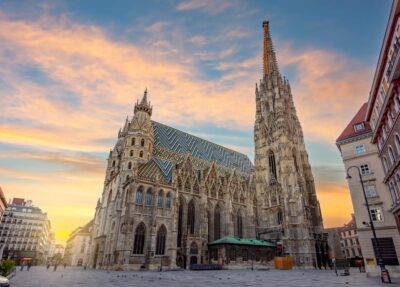
Guided Walking Tour of City Highlights & Hidden Gems
Read our review →

Vienna Historic Center Small Group Walking Tour
Read our review →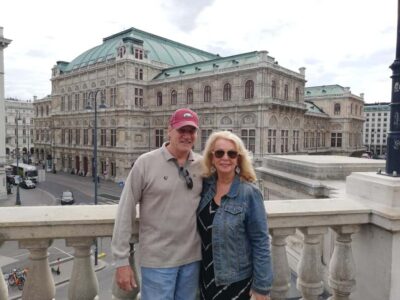
Ghosts and Legends Guided Nighttime Walking Tour
Read our review →Browse the lists this tour appears in