
Reviewed · HISTORICAL TOURS
Historical Hitler Walking Tour of Vienna
The most revealing part of this Vienna walk is not a single Hitler landmark. It is the way the guide connects Vienna’s cultural life, antisemitism, and Nazi rule across ordinary streets and grand imperial squares. You move from the State Opera to Heldenplatz, then to memorials that make the period painfully present.
I like the clear route through central Vienna and the way it includes Jewish history rather than treating Hitler as an isolated figure. I also like the strong guides, including Dieter, Wolfgang, Stephan, and Charles, who use maps, photographs, and careful storytelling. The main consideration is the 2.5-hour outdoor format. Winter can be cold, and the tour is more about historical explanation than dramatic Hitler relics.
In This Review
- Key points to know before booking
- Why this is more than a Hitler biography
- Starting at the State Opera
- The Memorial Against War and Fascism
- Hitler and the Academy of Fine Arts
- Heldenplatz and the March 1938 speech
- Judenplatz and the memory of Austrian Jews
- Morzinplatz and the former Gestapo headquarters
- The hidden Stadttempel Synagogue
- What the guides add to the experience
- Timing, weather, and walking comfort
- Is $32.65 a fair price?
- Who should book this walk?
- Should you book it?
- FAQ
- Where does the Historical Hitler Walking Tour of Vienna begin?
- What time does the tour start?
- Where does the tour end?
- How long does the tour last?
- What language is the tour offered in?
- Are entrance tickets included?
- What should I bring?
Key points to know before booking
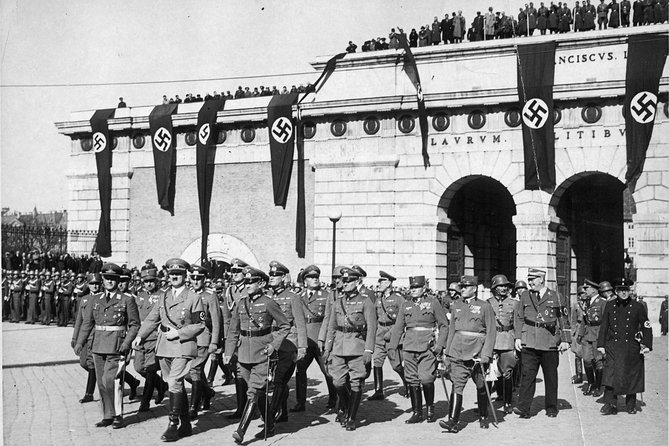
- Hitler’s Vienna is placed in context: The walk looks at his early years, the city that shaped his ideas, and Austria’s role after 1938.
- The route covers major memorials: You visit Heldenplatz, Judenplatz, Morzinplatz, and the Memorial Against War and Fascism.
- Jewish Vienna receives serious attention: The Judenplatz memorial and Stadttempel Synagogue help explain the city’s Jewish past and Nazi persecution.
- This is an easy-paced city walk: The route is on foot through central Vienna, with a moderate fitness level advised.
- Guides add visual material: Stephan has used an iPad with photographs and maps, while Dieter is praised for thoughtful explanations and group care.
- The tour ends well for dinner: Schwedenplatz has U-Bahn lines 1 and 4, plus many places to eat.
Why this is more than a Hitler biography
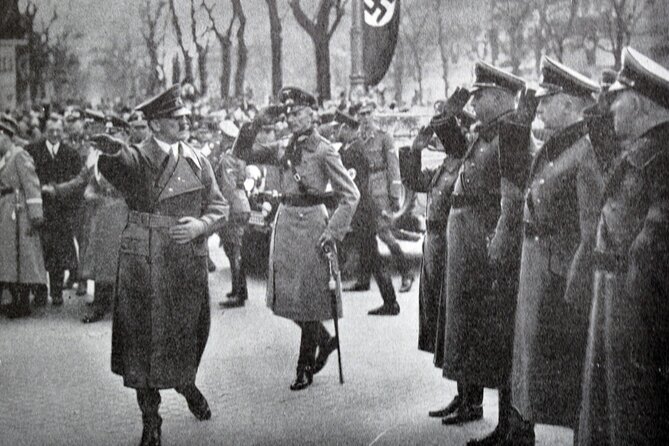
The title may suggest a tour devoted only to Adolf Hitler’s personal life. That is not quite what you get. The focus is Hitler’s relationship with Vienna, but the larger subject is how political ideas, art, religion, antisemitism, war, and public memory shaped the city.
The tour draws on the story of Hitler’s years in Vienna and his failed attempt to enter the Academy of Fine Arts. From there, it moves into the consequences of the Anschluss, Austria’s annexation by Nazi Germany in 1938, and the treatment of Jewish citizens, artists, and political opponents.
That wider approach is a strength. You are not simply shown places connected to Hitler and handed a list of dates. You are encouraged to think about why Vienna became receptive to Nazi ideas and how much of the city’s cultural and political life was damaged.
It is also important to set your expectations correctly. This is not a general Second World War walk, and it is not a tour of preserved Nazi buildings. Much of the value comes from the guide’s spoken account while you stand in places that look peaceful today.
The tour has earned a 4.8 rating from 887 reviews, with 96 percent recommending it. That is a strong signal, especially for a subject that depends heavily on the guide’s delivery. The occasional criticism is useful too: one person felt the name promised a more direct Hitler focus. If you want only Hitler’s biography, you may find the tour broad. If you want the Vienna setting and its moral history, the scope works well.
More walking tours in Vienna:
- Vienna: Guided Walking Tour of City Center Highlights
★ 4.7 · 4,989 reviews - Vienna: Vienna Central Cemetery Guided Walking Tour
★ 4.8 · 3,307 reviews - Vienna: Guided Walking Tour of City Highlights & Hidden Gems
★ 4.9 · 2,180 reviews
Starting at the State Opera
Meet outside the Albertina Museum at Albertinaplatz. The walk then heads to the Vienna State Opera, where the guide begins with the effect of National Socialism on the city’s arts scene.
The opera house opened in 1869 with Mozart’s Don Giovanni, attended by Emperor Franz Joseph and Empress Elisabeth. That grand beginning helps explain why the building matters. Vienna’s culture was not a side note in the Nazi period. It was central to the city’s identity, and the persecution of artists and employees changed who could work, perform, and remain safe.
Hitler visited the opera in 1938 after the Anschluss. The guide uses this setting to explain how the political takeover affected cultural life, including bans on certain works and the departure, persecution, and murder of artists and staff.
You spend about ten minutes here, free of an admission charge. Do not expect to enter the opera as part of the tour. The point is the exterior and the story attached to it, so you can return later for a performance or a separate interior visit if that interests you.
The Memorial Against War and Fascism
At nearby Albertinaplatz, the Memorial Against War and Fascism gives the walk a harder edge. Created by Austrian sculptor Alfred Hrdlicka, it was installed in 1988 as a reminder of the darkest period in Austria’s past.
This is not polished imperial Vienna. The memorial is deliberately severe, and the guide explains its dedication to the victims of war and fascism. It also offers a useful pause between the grand opera house and the personal story of Hitler’s early years.
I like this stop because it deals with public memory rather than only wartime events. Austria’s relationship with its Nazi past has long involved questions of responsibility, remembrance, and national self-image. A good guide can make those issues understandable without turning the stop into a lecture.
Again, the visit takes about ten minutes, and there is no admission fee. You remain outside, so comfortable shoes matter more than museum planning.
Hitler and the Academy of Fine Arts
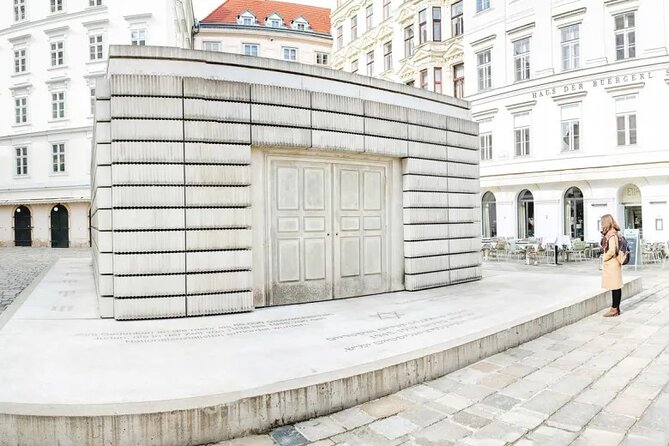
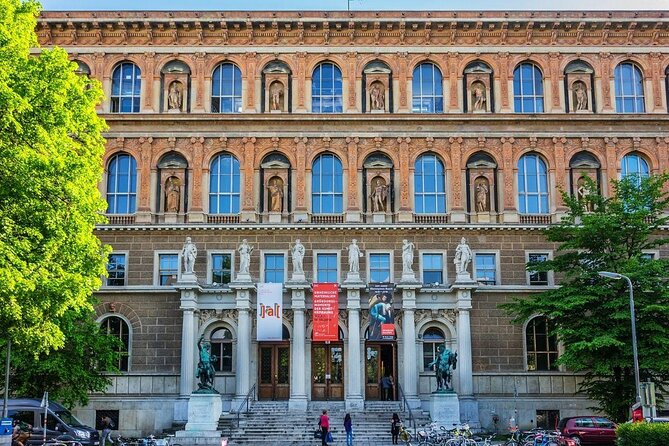
The walk continues to the Academy of Fine Arts, the art school that rejected Hitler as a student. This is one of the few stops tied directly to his early personal story.
The academy gives the guide a chance to discuss Hitler before his rise to power, when he was trying to build a life in Vienna. The important point is not the simplistic idea that one school rejection caused everything that followed. The useful question is how his early experiences, ambitions, prejudices, and political environment fit together.
This section is likely to appeal most to history buffs. You get the personal thread, but the guide keeps returning to the city around him. That balance matters because Hitler did not develop in a vacuum, and the tour is at its best when it avoids reducing history to one dramatic turning point.
The stop lasts around ten minutes. The experience remains a walking explanation rather than a visit inside the academy.
More history walks in Vienna:
- Vienna: Time Travel and Magic Vienna History Tour
★ 4.6 · 3,879 reviews - Vienna: World War II Historical Walking Tour
★ 4.8 · 1,772 reviews - Vienna Historic Center Small Group Walking Tour
★ 5.0 · 1,746 reviews - Time Travel-Magic Vienna History Tour Ticket
★ 4.5 · 1,099 reviews
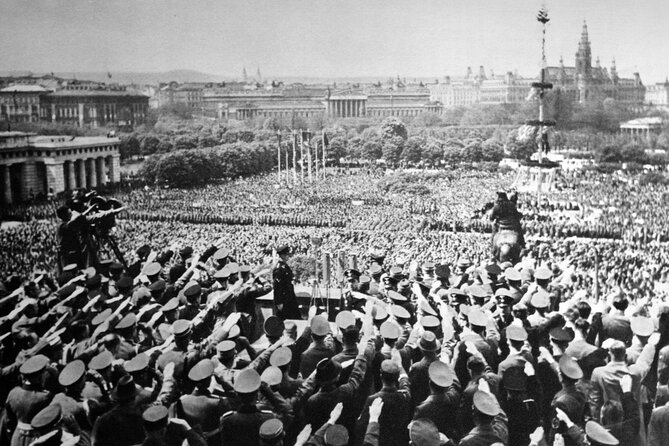
Heldenplatz and the March 1938 speech
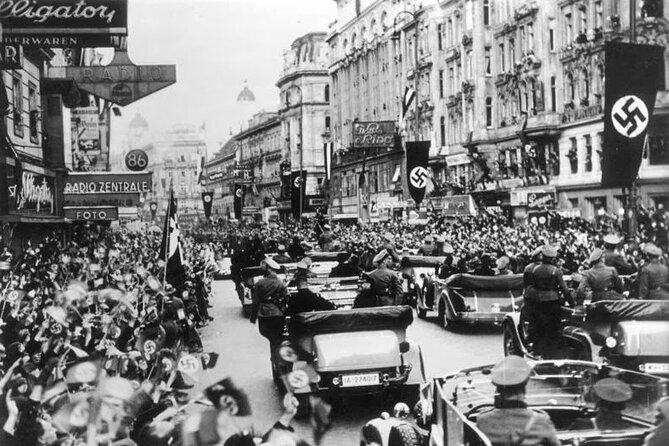
Heldenplatz is one of the most important places on the route. It is also one of Vienna’s most impressive public spaces, which makes the historical contrast especially stark.
On March 15, 1938, Hitler addressed a huge crowd from the balcony of the Neue Hofburg after Austria’s annexation by Nazi Germany. The speech has become a symbol of the Nazi seizure of power and of the broad support it received in Austria. It also became part of the trauma Austria had to face after the war.
Here, the guide can show you how architecture and public space were used for political theater. The square was not merely a backdrop. Its scale helped turn the event into a display of power and mass approval.
Allow about ten minutes at this stop, though the explanation may feel longer depending on questions. This is one of the places where photographs on a tablet, as guides such as Stephan have used, can help you picture the event as you look across the square.
Judenplatz and the memory of Austrian Jews
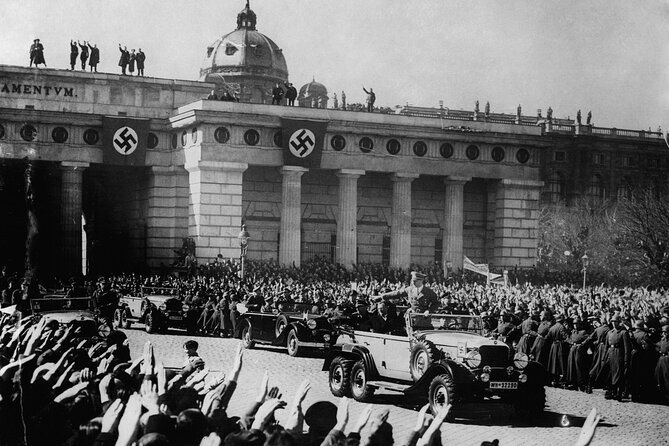
Judenplatz is the emotional center of the walk for many people. The Holocaust memorial commemorates more than 65,000 Austrian Jews murdered by the National Socialists between 1938 and 1945.
The memorial, also called the Memorial for the Austrian Jewish Victims of the Shoah, is not simply a marker for a distant event. It places Jewish loss in the middle of Vienna’s old center, among streets that you might otherwise see only as beautiful historic scenery.
The guide explains the place of Vienna’s Jewish population before and during the Holocaust, helping you understand that Jewish life was part of the city’s social and cultural fabric. That is one of the tour’s most valuable features. You are asked to see Jewish Vienna as a living part of the city, not only as a victim story.
The stop takes around ten minutes and is free. You may want a quiet moment here, since the subject is heavy and the memorial deserves more than a quick photograph.
Morzinplatz and the former Gestapo headquarters
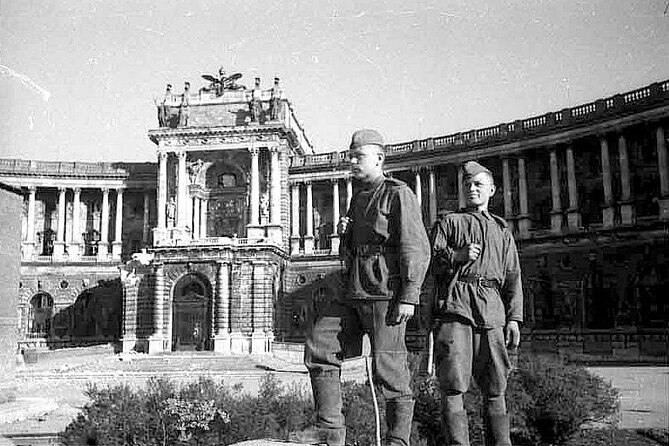
At Morzinplatz, the route reaches the site of the former Hotel Metropole. Before the Nazi period, it was a luxury hotel. Under National Socialism, it became one of the Gestapo’s most brutal headquarters in the Third Reich.
The contrast between a fashionable hotel and a site of imprisonment and abuse is chilling. It also shows how Nazi power took over familiar civic spaces. The address is not preserved as a grand historic attraction, so the guide’s explanation is essential.
This is another stop where the tour’s strength is interpretation. You are not entering a large museum with rooms full of objects. You are standing in the city and learning how the location was used, what it represented, and why its memory still matters.
The memorial at Morzinplatz adds a physical point of remembrance. Combined with Judenplatz, it gives the walk a clear human focus: the people persecuted, imprisoned, deported, and murdered.
The hidden Stadttempel Synagogue
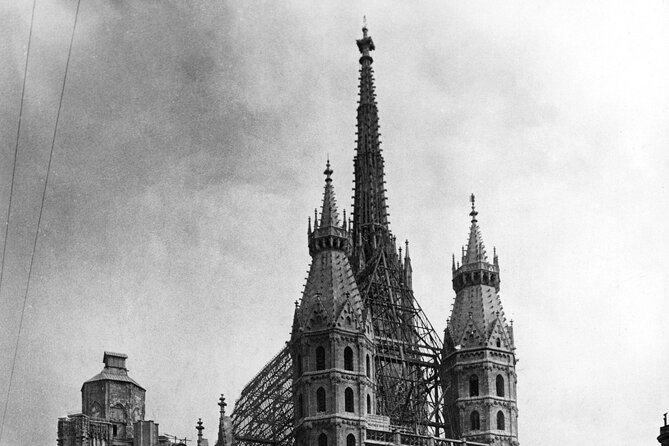
Near the end of the route, you learn why Vienna’s main synagogue, the Seitenstettentempel, is hidden behind a five-story apartment building on Seitenstettengasse.
Historical regulations required non-Catholic places of worship to be concealed from the street. The synagogue’s position behind the tenement building is a reminder of the restrictions placed on religious minorities long before the Nazi period.
The entrance carries the words, Come to his gates with thanksgiving, to his courts with praise. The building’s hidden position gives that inscription an added force. The synagogue is present, but not presented openly from the street.
This stop is known as the Jewish Vienna information point and helps link older religious restrictions with the later catastrophe. The tour does not treat antisemitism as something that appeared overnight in 1938. Instead, it shows a longer background of exclusion and prejudice.
The walk ends a few minutes from Schwedenplatz. You are not left in an isolated area. U-Bahn lines 1 and 4 serve the square, and restaurants make it a handy place to continue the evening.
What the guides add to the experience
Because this is a history walk, the guide matters enormously. Dieter is praised for calm, clear storytelling, a relaxed pace, and taking care of the group. Wolfgang is described as warm, thoughtful, and especially strong at linking Vienna before and after the Second World War.
Stephan has used an iPad with photographs and maps to add visual context. Charles is praised for bringing extra detail even to people who already know a fair amount about Hitler’s rise. Other guides, including Siggy, are described as engaging and open to questions.
You should not assume the same guide will lead every departure. The important point is that the experience depends on a person explaining difficult material well. The best guides keep the focus on Vienna and Austria, rather than turning the walk into a general biography of Hitler.
One practical issue is sound. On one departure, it was difficult to hear the guide through the listening device. Stay close, ask for repetition when needed, and do not hesitate to speak up if street noise gets in the way.
Timing, weather, and walking comfort
The tour begins at 2:30 pm and lasts about two and a half hours. It is long enough to provide real context, but short enough to fit into a day of sightseeing if you plan your schedule carefully.
You need a moderate level of fitness. The walk is described as easy-paced, but you will be outdoors for a substantial part of the afternoon and moving between several central locations. Wear comfortable shoes and clothes.
Vienna weather can change quickly. Bring water, sunblock, and a raincoat or umbrella. Cold weather deserves special attention. Several guides have included indoor pauses so people could warm up, but you should still dress for a long afternoon outside.
The group can have up to 25 people. That is not a private walk, and the guide may need to manage a group across busy streets. Arrive at Albertinaplatz with enough time to identify the meeting point and guide. One past problem involved people being left behind near the busy starting area, so keep the group in sight once the walk begins.
Service animals are allowed, and the meeting and ending points are near public transport. Hotel pickup, food, drinks, and guide gratuities are not included.
Is $32.65 a fair price?
At $32.65 per person, I consider this a sensible price for a 2.5-hour guided walk in central Vienna. You are paying for a licensed guide, not for entry to attractions, so the value depends on how much you want explanation and historical structure.
The major sites on the route are free to view from outside. You could walk past many of them without paying anything. What you cannot easily recreate is the sequence: Hitler’s early Vienna, the arts under Nazism, the 1938 speech, Jewish persecution, the Gestapo site, and the hidden synagogue.
That makes the tour a good buy for history-minded visitors who want the city to make sense. It is less useful if you prefer entering museums, seeing original objects, or exploring at your own pace.
The price also compares well with the time involved. A good guide gives you two and a half hours of organized history, answers questions, handles the route, and points out places you might otherwise miss. I would budget a little extra for a tip if the guide has done a strong job, though gratuities are optional.
Who should book this walk?
I would choose this tour if you care about modern European history, Jewish Vienna, political memory, or the link between public spaces and power. It suits adults, older teenagers, teachers, students, and anyone who wants more than the usual palaces and coffeehouses.
You do not need to arrive as a specialist. The guides explain the setting and accept questions. But you should be willing to listen for long stretches while standing outdoors.
This is not the best choice for a first-time Vienna walk focused on architecture, imperial life, or music alone. It also may disappoint you if you expect a tour built around preserved Hitler sites or a detailed account of every military campaign in the Second World War.
Should you book it?
Book it if you want a serious, city-based account of Hitler’s connection to Vienna and Austria’s role in the Nazi period. The strongest parts are the State Opera, Heldenplatz, Judenplatz, and Morzinplatz, where the guide turns familiar streets into places of historical consequence.
I especially like that the route gives Jewish Vienna a central role and ends near transport and restaurants. Choose a mild-weather date if possible, wear good shoes, and arrive early at Albertinaplatz.
You can cancel for a full refund up to 24 hours before the start time. If poor weather or too few bookings cancel the tour, you are offered another date or a full refund. For a history buff, $32.65 is a fair exchange for a focused afternoon and a better understanding of Vienna’s darkest decades.
FAQ
Where does the Historical Hitler Walking Tour of Vienna begin?
The tour begins at Albertinaplatz, outside the Albertina Museum, in central Vienna.
What time does the tour start?
The scheduled start time is 2:30 pm.
Where does the tour end?
The walk ends a few minutes from Schwedenplatz, near U-Bahn lines 1 and 4 and several restaurants.
How long does the tour last?
The tour lasts approximately 2 hours and 30 minutes.
What language is the tour offered in?
The tour is offered in English.
Are entrance tickets included?
The tour includes a licensed guide. Food, drinks, hotel pickup and drop-off, and gratuities are not included. The listed stops have no admission ticket charge as part of the walk.
What should I bring?
Wear comfortable shoes and clothes. Bring water, sunblock, and a raincoat or umbrella because Vienna weather can be unpredictable. A moderate level of physical fitness is advised.
Just added around Vienna
- Private Tour from Vienna to Melk and Dürnstein★ 4.5 · 3 reviews
- Vienna: Johann Strauss 200th birthday anniversary exhibition★ 4.7 · 3 reviews
- Vienna Private Full Day Tour – Tickets to Schönbrunn & Lunch★ 5.0 · 3 reviews
- Private Salzburg Day Trip from Vienna★ 4.0 · 3 reviews
- Vienna: Entry Ticket Belvedere 21 & Contemporary Art★ 4.3 · 3 reviews
- Full-Day Private Trip from Vienna to Budapest★ 4.5 · 3 reviews
- Vienna by Night: Private Evening Food and Drink Tour★ 5.0 · 3 reviews
- Semi-Private Tour: Central Europe &Balkans from Vienna to Athens★ 5.0 · 3 reviews
Historical Tours, compared.
Vienna Historic Center Small Group Walking Tour
Read our review →
Skip-the-Line Schonbrunn Palace Guided Tour and Vienna Historical City Tour
Read our review →
Vienna Mozart Concert in Historical Costumes at the Musikverein
Read our review →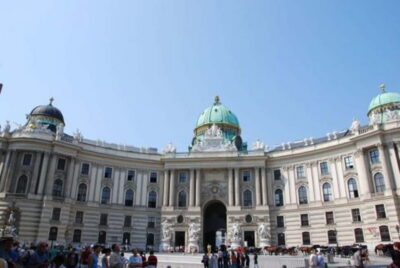
Vienna Classical Concert – Strauss in Historic 1837 Hall
Read our review →Browse the lists this tour appears in